Stone, Space, and Sound: How Britain's Cathedrals Taught Its Composers to Listen
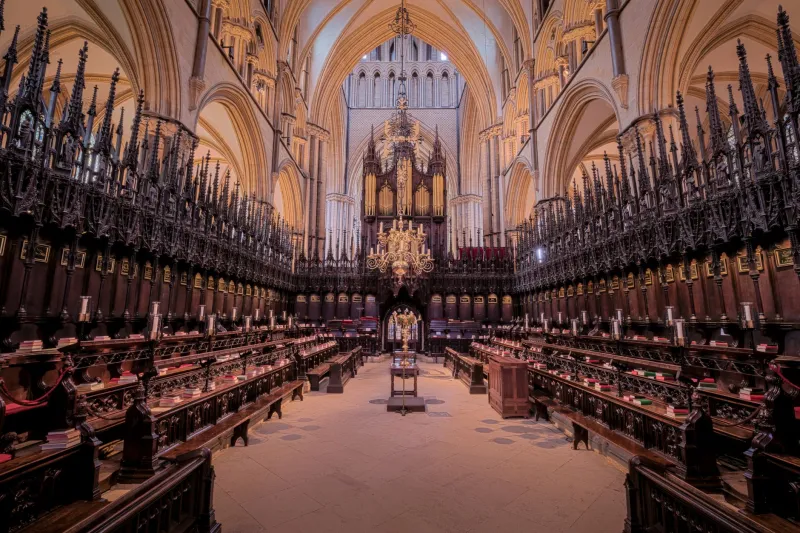
Long before the science of acoustics possessed its present vocabulary, British composers understood something that no textbook could easily articulate: that a building has a voice of its own. To write music for a cathedral was not simply to provide notes for singers. It was to enter into a dialogue with centuries of accumulated stone, with the geometry of arches and the absorptive properties of oak choir stalls, with the particular way that sound moves through spaces designed not for entertainment but for transcendence.
This dialogue has shaped British choral music in ways that remain audible today, encoded in the characteristic textures of a tradition unlike any other in Western music.
The Architecture of Resonance
The acoustic behaviour of a medieval cathedral is principally determined by its reverberation time—the duration for which sound persists after its source has ceased. In a large stone building such as Canterbury, Salisbury, or Durham, this reverberation may extend to seven or eight seconds under certain conditions. For the spoken word, such an environment is challenging. For music composed with awareness of it, the effect can be sublime.
Polyphonic choral music, in which multiple independent vocal lines weave together simultaneously, benefits enormously from extended reverberation. As each line sustains and overlaps with those that follow, the acoustic tail of the building creates a natural harmonic enrichment that no composer could write explicitly into a score. The building completes the music, adding a dimension of sound that exists only in that particular space.
This is not a coincidence. The composers who worked within cathedral traditions were acutely sensitive to these properties, shaping their music accordingly. Long, sustained notes allow the reverberation to develop fully. Gradual harmonic progressions, moving more slowly than would feel natural in a drier acoustic, give the building time to respond. Rapid, rhythmically complex passages, by contrast, blur into indistinction in such spaces—a lesson that cathedral composers learnt quickly and applied consistently.
Byrd and the Elizabethan Ear
William Byrd, who served as a Gentleman of the Chapel Royal throughout much of the Elizabethan period, offers perhaps the most instructive early example of a composer in active conversation with his acoustic environment. His Latin motets, written during a period of considerable personal risk—Byrd remained a practising Catholic in an age of religious persecution—display a mastery of sustained vocal lines and carefully graduated harmonic movement that speaks directly to the resonant spaces in which they were intended to sound.
Byrd's settings of texts from the Gradualia, published in the early seventeenth century, employ a characteristic technique of overlapping imitative entries, in which each voice introduces a melodic fragment that is then taken up and extended by the others. In a dry acoustic, this produces a pleasing sense of dialogue. In a resonant stone interior, the effect is transformed: the overlapping tails of each entry blend into a continuous harmonic wash, the individual lines dissolving into a collective sound of remarkable richness.
Musicologists have long noted that Byrd's music sounds categorically different in the spaces for which it was designed. Contemporary performances in venues such as the Chapel Royal at Hampton Court or the Fitzalan Chapel at Arundel Castle bear this out with striking force.
The Victorian Reinvention
The nineteenth century brought a renewed engagement with cathedral music, driven in part by the Gothic Revival and its accompanying enthusiasm for medieval forms. Composers such as Samuel Sebastian Wesley, whose long tenure at various English cathedrals gave him an intimate knowledge of their acoustic properties, approached the challenge of writing for these spaces with both scholarly rigour and creative ambition.
Wesley's anthems are notable for their spacious harmonic language and their sensitivity to vocal blend—qualities that reflect a composer who had spent decades listening to music in reverberant environments and understanding precisely what those environments demanded. His cathedral service settings move with a deliberateness that can seem sluggish in concert hall performance but assumes an entirely different character in the spaces for which they were conceived.
Edward Elgar, whose formative musical experiences were shaped by the Three Choirs Festival—rotating annually between the cathedrals of Gloucester, Worcester, and Hereford—absorbed these lessons deeply. The Dream of Gerontius, premiered at Birmingham Town Hall in 1900 to a reception that failed to do it justice, found its true home in subsequent Three Choirs performances, where the acoustic of the cathedral transformed its expansive choral writing into something approaching the visionary. Elgar himself acknowledged that the work breathed differently in cathedral space.
Contemporary Acoustical Research
Modern acoustic science has begun to quantify what composers and performers have long understood intuitively. Researchers at institutions including the University of Salford and various European acoustics laboratories have developed sophisticated methodologies for measuring and modelling the acoustic properties of historic buildings, producing what are known as impulse response recordings—essentially, the acoustic fingerprint of a space.
These recordings can be applied digitally to dry studio recordings, allowing researchers to hear, with considerable accuracy, how a piece of music would have sounded in a specific building at a specific period in history. The results are frequently revelatory. Music that seems harmonically dense or rhythmically conservative in its written form reveals an entirely different character when heard through the acoustic lens of its intended environment.
Such research has also shed light on changes to cathedral acoustics over time. Victorian restoration programmes, which frequently involved the introduction of wooden flooring, upholstered seating, and additional furnishings, significantly altered the reverberation characteristics of many English cathedrals. Music written for a medieval acoustic may sound quite different in the same building today, a consideration that informs contemporary performance practice among historically informed ensembles.
The Living Tradition
Britain's cathedral choral tradition remains one of the most distinctive in the world, and the acoustic intimacy between building and repertoire continues to evolve. Contemporary composers commissioned to write for cathedral choirs—among them John Tavener, James MacMillan, and Judith Weir—have engaged consciously with the acoustic properties of their intended venues, continuing a dialogue that stretches back to the earliest days of English polyphony.
For those who attend evensong in one of Britain's great cathedral churches, the experience carries within it the accumulated weight of this long conversation. The sound that fills the nave is not merely the product of trained voices and written notes. It is the result of centuries of listening—of composers attending to the voice of stone and learning, with extraordinary patience and creativity, how to answer it.