Small Labels, Grand Lives: The Forgotten Art of the British Bookplate and What It Reveals
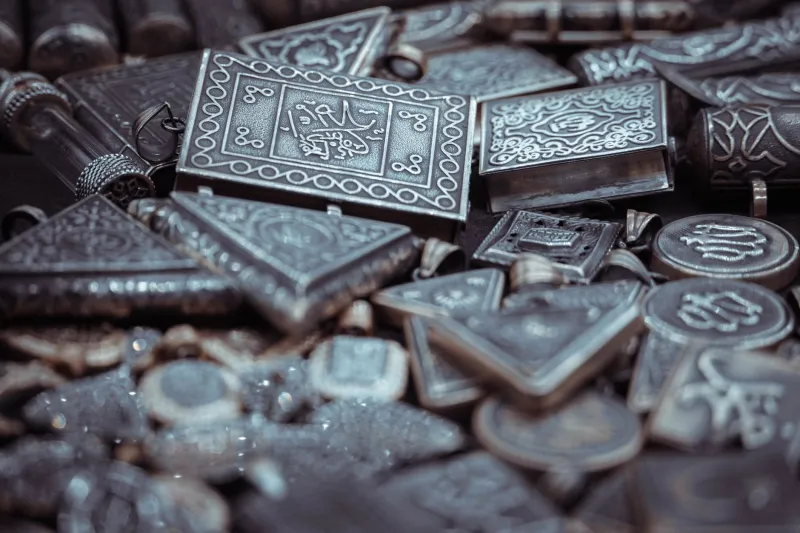
Open an old book — one acquired from a country house sale, or rescued from a dealer's box at a provincial fair — and there is always the possibility of a discovery. Tucked inside the front board, partially obscured by a later bookseller's stamp or the pencilled price of a previous owner, a small printed label may be waiting. An armorial crest. A motto in Latin. A landscape vignette, perhaps, or an allegorical figure. A name, engraved with the quiet confidence of a person who wished the world to know that this volume belonged to them.
This is the bookplate: a form so modest in scale and so rich in implication that it has sustained the devotion of collectors, scholars, and art historians for well over a century. In Britain, where the private library was long regarded as both a mark of cultivation and a statement of social identity, the bookplate achieved a particular refinement. And the examples that survive — from the heraldic labels of Tudor nobility to the sinuous Art Nouveau designs commissioned by Edwardian aesthetes — constitute, taken together, a visual archive of remarkable depth and intimacy.
The Emblem of Ownership
The British bookplate has its origins in the late fifteenth century, appearing first among the libraries of aristocratic and ecclesiastical collectors who wished to assert ownership over volumes acquired at considerable expense. Early examples were simple woodcut prints, often incorporating armorial bearings and little else. By the seventeenth century, however, engravers were producing work of considerable sophistication: elaborate compositions in which heraldic elements were framed by swags, putti, architectural motifs, and allegorical figures drawn from classical mythology.
The eighteenth century brought what many historians regard as the golden age of the British bookplate. The great engravers of the period — among them William Jackson, James Mynde, and the incomparable George Vertue — produced designs that were, in miniature, as accomplished as anything produced in the wider graphic arts. Collectors who commissioned these labels were not merely marking their books; they were making a statement about their education, their taste, and their place in the cultural order.
 Photo: George Vertue, via m.media-amazon.com
What makes the study of these objects so compelling is precisely their dual nature. They are simultaneously works of art and documents of identity — and it is the latter quality that has drawn a growing community of researchers to examine them with something approaching detective fervour.
Reading the Label
A bookplate, properly studied, can yield an extraordinary quantity of information about its commissioner. The choice of imagery — classical or romantic, heraldic or pictorial — speaks to aesthetic preferences. The motto, where one appears, may reveal religious convictions or intellectual allegiances. The name of the engraver, often inscribed in tiny lettering at the foot of the design, connects the plate to a specific moment in the history of British printmaking. And the books in which the plates are found, when traced and catalogued, begin to sketch the outlines of a private library — and, by extension, a private mind.
The musicologist and bibliophile Dr Susan Alderton, who has spent the past decade cataloguing bookplates associated with British composers and musicians, describes the process as 'a form of biographical archaeology.' In one celebrated instance, she was able to establish, through the consistent appearance of a particular bookplate in volumes of music theory, that a composer previously assumed to have had little interest in contemporary continental thought had in fact assembled a substantial collection of French and German theoretical texts. The bookplate, humble as it was, became a corrective to received opinion.
'The wonderful thing about bookplates,' she observes, 'is that they were never intended to be evidence. They were private gestures, made for personal satisfaction. Which is precisely what makes them so revealing.'
The Artists Who Made Them
The history of the British bookplate is also a history of some of the country's finest draughtsmen and engravers. In the Victorian period, the form experienced a remarkable revival, driven in part by the general enthusiasm for collecting and connoisseurship that characterised the age, and in part by the emergence of the Ex Libris Society, founded in 1891, which brought together plate-owners, artists, and scholars in a shared celebration of the form.
Among the artists who contributed to this revival, none is more celebrated than Charles William Sherborn, whose meticulous line engravings set a standard that later practitioners measured themselves against. But the Victorian bookplate was not exclusively the preserve of traditional engravers. Artists associated with the Arts and Crafts movement — among them Walter Crane and Gleeson White — brought a new vocabulary of naturalistic ornament and symbolic imagery to the form, producing designs that were unmistakably of their moment while remaining fully cognisant of the tradition they were extending.
 Photo: Walter Crane, via wallpapers.com
The Edwardian and early twentieth-century periods saw a further transformation, as the sinuous lines of Art Nouveau found their way into bookplate design. Plates commissioned during these years are often among the most visually arresting examples of the form: elongated female figures, flowing botanical motifs, lettering that seems to grow organically from the surrounding imagery. Many were commissioned by figures at the heart of Britain's literary and artistic life, and the plates themselves — small, exquisite, intensely personal — are now among the most keenly sought by specialist collectors.
Lost Libraries, Recovered Connections
For the scholars who work in this field, the most exciting discoveries come not from individual plates but from the patterns that emerge when multiple examples are assembled and compared. A bookplate appearing consistently in volumes associated with a particular literary circle can map the movement of books between friends, patrons, and correspondents. The presence of a plate in an unexpected context — a composer's library, say, containing volumes one might associate with a poet — can open entirely new lines of inquiry.
The dispersal of Britain's great private libraries, accelerating through the twentieth century as death duties and changing fortunes forced the sale of country house collections, scattered these connections across auction rooms, dealers, and private hands. Reassembling them, even partially, requires patience, specialist knowledge, and a degree of good fortune. But the rewards, for those willing to undertake the work, are considerable.
At a recent specialist sale in London, a collection of volumes bearing the bookplate of a prominent Victorian patron of music sold for well above their estimated values — not because of the books themselves, but because of what the accumulated plates revealed about the collector's relationships with several major composers of the period. The label had become the exhibit.
A Form Worth Rediscovering
The bookplate is not, it must be said, a form that commands wide public attention in the present day. It occupies a niche within a niche: the intersection of book collecting, print history, and biographical scholarship. But for those who engage with it seriously, it offers something that larger and more celebrated art forms cannot: access to the intimate, the personal, and the unguarded.
Britain's cultural heritage is, in many respects, a heritage of grand gestures — cathedrals, symphonies, great novels. The bookplate reminds us that the private gesture — the small label pasted inside a beloved volume, bearing one's name and one's device, asserting quietly that this book was read and cherished and owned — is also a form of cultural expression worth preserving and worth understanding. In these diminutive rectangles of paper and ink, the inner lives of Britain's cultural figures are still waiting to be read.