Keeper of the Word: The Victorian Theatre Prompter and the Art of the Invisible Performance
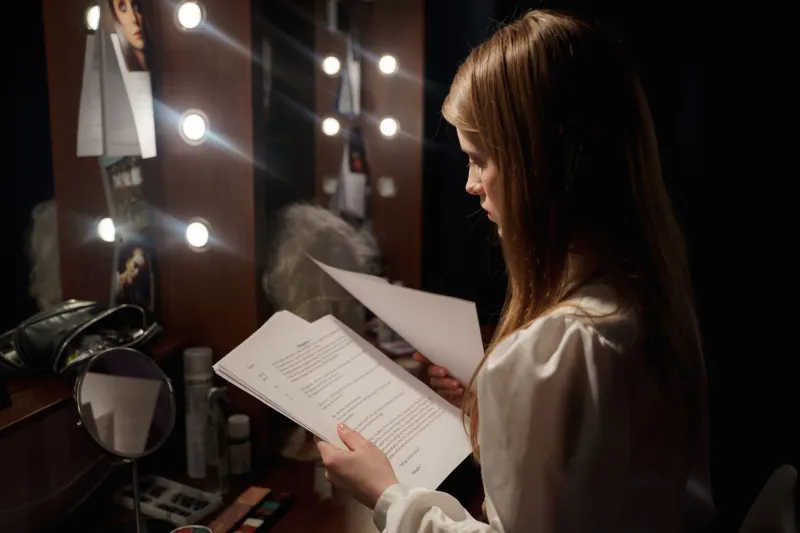
Every art form has its invisible practitioners — those whose contribution to the finished work is essential yet whose names appear nowhere in the programme, whose faces are unknown to the audience, and whose efforts are recognised only in the breach, when something goes wrong. In the long history of British theatre, no figure better exemplifies this condition than the prompter: that quiet, watchful presence stationed in the wings, prompt book open before them, ready to supply the word that a nervous actor's memory had momentarily surrendered.
But to describe the Victorian theatre prompter as merely a supplier of forgotten lines is to diminish the role almost beyond recognition. The prompter was, in practice, one of the most consequential figures in any theatre company — a specialist whose knowledge of the performed text was frequently more detailed and reliable than that of the actors themselves, and whose responsibilities extended far beyond the narrow function that the job title implies.
A Position of Ancient Standing
The office of prompter in the British theatre has roots that reach back to at least the Restoration period, when the re-establishment of licensed playhouses after the Puritan interregnum created an immediate and urgent need for theatrical professionals capable of managing the practical demands of regular performance. In those early decades, the prompter was frequently one of the most experienced members of a company — someone whose theatrical knowledge encompassed not merely the texts of individual plays but the broader practical vocabulary of stagecraft.
By the eighteenth century, the role had become sufficiently established to attract figures of genuine intellectual distinction. John Downes, prompter at the Duke's Theatre and later at Drury Lane from the 1660s until the early eighteenth century, compiled his Roscius Anglicanus (1708) — a record of theatrical performances and performers that remains one of the most valuable primary sources for the Restoration stage — drawing directly on the accumulated knowledge he had gathered in the wings over four decades. Downes is the prompter as historian, and his example suggests that the role, at its best, produced individuals of unusual cultural significance.
 Photo: Drury Lane, via images.squarespace-cdn.com
 Photo: John Downes, via www.reitpaedagogik-vorarlberg.at
The Prompt Book as Living Document
The most tangible legacy of the British theatrical prompter is the prompt book: that annotated, amended, and frequently battered copy of a play text that served as the operational record of a production. These volumes, hundreds of which survive in the collections of the British Library, the Victoria and Albert Museum's Theatre and Performance Archive, and various regional repositories, are among the most fascinating documents in the history of British culture.
A Victorian prompt book is not a clean text. It is an accumulation of decisions, revisions, and practical wisdom laid down over multiple performances and, in many cases, multiple revivals. Stage directions are added in pencil, crossed out, and rewritten. Cuts are marked, sometimes with explanatory notes that reveal the reasoning behind them. Lighting cues, sound effects, and scene transitions are recorded in a private shorthand that varies from prompter to prompter and from theatre to theatre. Cast changes are noted in the margins, sometimes with terse assessments of the new performer's reliability.
To read one of these volumes is to gain access to the living reality of Victorian theatrical performance in a way that no printed text, no review, and no memoir can quite replicate. The prompt book for Henry Irving's celebrated production of Hamlet at the Lyceum in 1874, preserved in the V&A's collections, contains annotations in at least four different hands, recording the evolution of the production across its initial run and subsequent revivals. The prompter's hand is identifiable by its consistency and its practical focus — less interested in interpretation than in execution, in the mechanics of making the thing work night after night.
 Photo: Henry Irving, via gsp-image-cdn.wmsports.io
More Than a Whisper
The popular conception of the prompter as a whisperer of forgotten lines, though not entirely inaccurate, obscures the full range of the role's responsibilities. In a well-run Victorian theatre company, the prompter served as something very close to what a contemporary theatre would call a stage manager — responsible for the co-ordination of all the practical elements that combined to produce a performance.
This included the calling of cues for scene changes, the management of props and their placement in the wings, the supervision of understudies, and the maintenance of the prompt book itself as an accurate record of the production in its current state. In companies that maintained a large repertoire — as most Victorian theatres did, presenting different plays on different nights of the week and changing the programme regularly — the prompter's role as institutional memory was particularly critical. The ability to revive a production that had not been performed for several months, and to do so accurately and efficiently, depended almost entirely on the quality of the prompt book and the prompter's mastery of its contents.
Some prompters went considerably further, functioning as informal dramaturgs whose understanding of the play text was sufficiently deep to allow them to advise on questions of interpretation and staging. George Cressall, prompter at the Princess's Theatre in Oxford Street during the 1850s and 1860s, is known from surviving correspondence to have contributed substantively to the staging decisions of Charles Kean's celebrated Shakespearean revivals — productions whose archaeological exactitude and visual splendour were among the most admired theatrical achievements of the mid-Victorian period. Kean's letters refer to Cressall with a respect that suggests something considerably warmer than the relationship between an employer and a functionary.
Women in the Wings
One of the more striking features of the prompter's role, as it developed through the nineteenth century, is the degree to which it was occupied by women. At a time when women's participation in theatrical life was constrained by convention and, in some cases, by contractual arrangement, the prompter's position — invisible, unacknowledged, and therefore uncontroversial — offered a means of professional engagement with the theatrical world that was available when many other routes were not.
Several of the most accomplished Victorian theatre prompters were women whose names appear in company records with the same quiet consistency that characterises their role — present at every performance, essential to every production, and almost entirely absent from the theatrical histories written by and for the performers who stood in the light they helped to sustain. Their prompt books, where they survive, are frequently indistinguishable in quality and authority from those of their male counterparts — a reminder that professional competence has never been the exclusive property of those whose contributions are publicly acknowledged.
Reclaiming a Lost Art
The decline of the prompter as a distinct theatrical role in the twentieth century was a gradual process, driven partly by the professionalisation of stage management and partly by changes in rehearsal practice that made the constant presence of a prompt less necessary. By the mid-twentieth century, the role had been largely absorbed into the broader responsibilities of the deputy stage manager, and the distinctive figure of the prompter — with their particular combination of textual knowledge, practical authority, and absolute invisibility — had effectively ceased to exist.
What survived, and what continues to reward the attention of anyone seriously interested in the history of British theatrical performance, is the prompt book itself. These volumes, patiently compiled and carefully maintained by men and women whose names are largely forgotten, constitute a record of how Britain's theatrical heritage was actually performed — not as it appeared on the printed page, but as it lived and breathed on the stage. They are, in their quiet and unassuming way, among the most important documents in the archive of British culture, and the figures who created them deserve, at last, their curtain call.