Keepers of the Loft: Britain's Church Organists on the Edge of Silence
Keepers of the Loft: Britain's Church Organists on the Edge of Silence
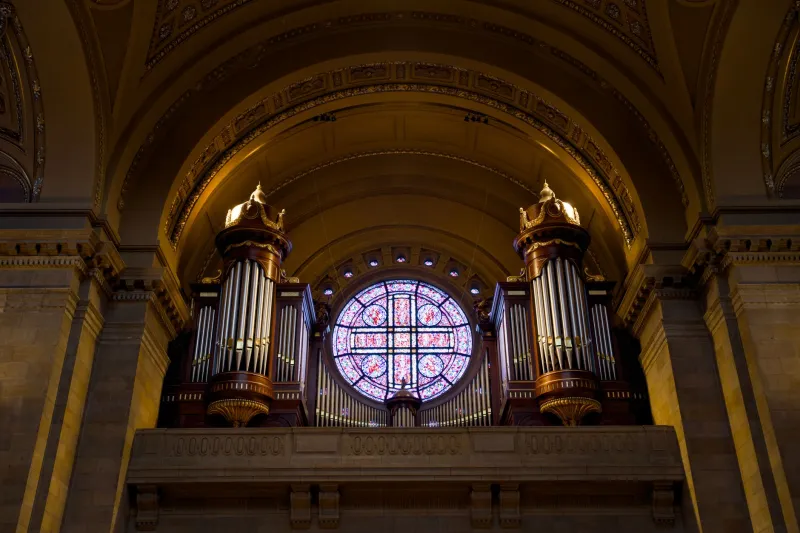
There is a particular quality to the silence that precedes the first note. It settles over the nave like a held breath — the congregation seated, the candles lit, the morning light pressing through stained glass onto cold stone flags. Then, from somewhere above and behind, the organ speaks. It does not merely begin; it fills the entire architecture with sound, as though the building itself has found a voice.
For the men and women who occupy Britain's church organ lofts, this moment is the culmination of a week's preparation, a lifetime's devotion, and — increasingly — an act of quiet defiance against the forces that threaten to make them the last of their kind.
A World Above the Congregation
To climb into an organ loft is to enter a separate country. The view from above is unlike anything a worshipper in the pews will ever see: the crowns of heads, the geometry of the roof timbers, the altar reduced to a distant arrangement of candlelight and cloth. The instrument itself dominates the space — banks of keys, rows of stops labelled in Latin or archaic English, pedals worn smooth by generations of feet. The smell is distinctive: aged leather, dust, the faint sweetness of old pipe metal.
Margaret Hollis has played the organ at a medieval parish church in Lincolnshire for thirty-one years. She inherited the post from her predecessor, who had held it for twenty-six years before her. The instrument she plays was installed in 1887, rebuilt in the 1950s, and has not been substantially altered since. She knows every quirk of it — the cipher that occasionally sounds unbidden on a damp morning, the swell pedal that must be coaxed rather than pressed, the stop labelled 'Dulciana' that produces a tone she describes, simply, as the sound of the church itself.
 Photo: Margaret Hollis, via c8.alamy.com
'People ask me whether it feels lonely up here,' she says. 'But it never has. You're part of every service, even when no one can see you. Especially then.'
The Weight of Custodianship
Britain's ecclesiastical organs represent one of the country's most extraordinary and least celebrated forms of cultural heritage. Instruments by the great builders — Father Smith, Renatus Harris, Henry Willis, William Hill — survive in parish churches, college chapels, and cathedrals across the land. Some are centuries old; many are irreplaceable. The organist who sits before them is not merely a musician but a steward, responsible for understanding the instrument's history, maintaining its repertoire, and ensuring that the tradition of sacred music it embodies continues to be heard.
This responsibility is rarely acknowledged and almost never rewarded financially. The majority of Britain's parish church organists are paid a modest honorarium — if they are paid at all. Many serve voluntarily, driven by a combination of musical passion, religious commitment, and an acute awareness that if they were to step away, no one might step forward to replace them.
David Carnforth, who has held the post of organist at a Grade I listed church in Somerset for eighteen years, is candid about the economics. 'I have a day job,' he says. 'This has never been a living. But the thought of this instrument standing silent — of these pipes never being heard again — is something I find genuinely distressing. These instruments were built to be played. They deteriorate when they are not.'
 Photo: David Carnforth, via i.pinimg.com
Dwindling Congregations, Deepening Commitment
The crisis facing Britain's church organists is inseparable from the broader decline in regular church attendance. Smaller congregations mean reduced income for parishes, which in turn means less money for instrument maintenance, fewer resources for music programmes, and — in the most difficult cases — the decision to dispense with a professional or semi-professional organist altogether in favour of a digital keyboard or a recorded soundtrack.
The figures, while contested, are sobering. The Royal College of Organists has long documented the shrinking pool of trained church organists, particularly in rural areas, and the ageing demographic of those who remain. Recruitment is a persistent challenge: the years required to develop true proficiency at the instrument, combined with the modest financial returns, make it an unlikely career choice for younger musicians navigating an already precarious profession.
And yet the commitment of those who remain is, if anything, intensified by the precariousness of the situation. Several organists interviewed for this article spoke of a heightened sense of purpose — a conviction that what they do matters precisely because it is under threat.
'I think about the people who played this instrument before me,' says Eleanor Vane, organist at a Victorian church in the West Midlands. 'I think about the music that has been made in this space, the funerals and weddings and ordinary Sundays going back a hundred and fifty years. That continuity is worth something. It is worth a great deal.'
 Photo: Eleanor Vane, via img.autotrader.co.za
The Instrument as Monument
Beyond the human dimension, there is the question of the instruments themselves. A pipe organ is among the most complex objects that a craftsman can produce: thousands of individual components — pipes, trackers, pallets, wind chests — all interdependent, all requiring regular maintenance and periodic restoration. The great Victorian builders created instruments intended to last centuries, and many have done so. But longevity demands attention.
The cost of restoring or rebuilding a historic organ can run into hundreds of thousands of pounds, a sum far beyond the resources of most parish churches. Heritage bodies, charitable trusts, and the generosity of individual donors have preserved many instruments that might otherwise have been lost. Others have not been so fortunate. Across Britain, historic organs have been removed, sold, or simply allowed to fall into irreparable disrepair.
For those organists who tend instruments of genuine historical significance, the awareness of fragility is ever-present. 'Every time I sit down to play,' says one cathedral assistant organist, 'I am aware that I am in conversation with every musician who has sat in this seat before me. That is not a burden. It is a privilege. But it is also a responsibility that I take very seriously.'
A Tradition Worth Preserving
It would be easy to frame this as a story of inevitable decline — a venerable tradition quietly yielding to the pressures of a changing society. But that would be to misrepresent the spirit of the people who inhabit these lofts. There is, among Britain's working church organists, a remarkable absence of self-pity. What one encounters instead is a combination of realism about the challenges and a fierce, practical determination to continue.
New training initiatives, digital resources, and the efforts of organisations such as the Royal College of Organists and the Incorporated Association of Organists are working to attract younger players and ensure that the knowledge held by veteran musicians is not lost when they eventually lay down their duties. The results are modest but real.
What is certain is that the tradition these musicians embody — of sacred music performed on historic instruments in ancient buildings, as an act of devotion to both art and faith — represents something that cannot be replicated digitally or reconstructed once it is gone. The organ loft is not merely a place in a building. It is a vantage point from which British musical history can be heard, still sounding, in the present tense.