Patterns in Bronze: The Unwritten Art of Britain's Bell-Ringers
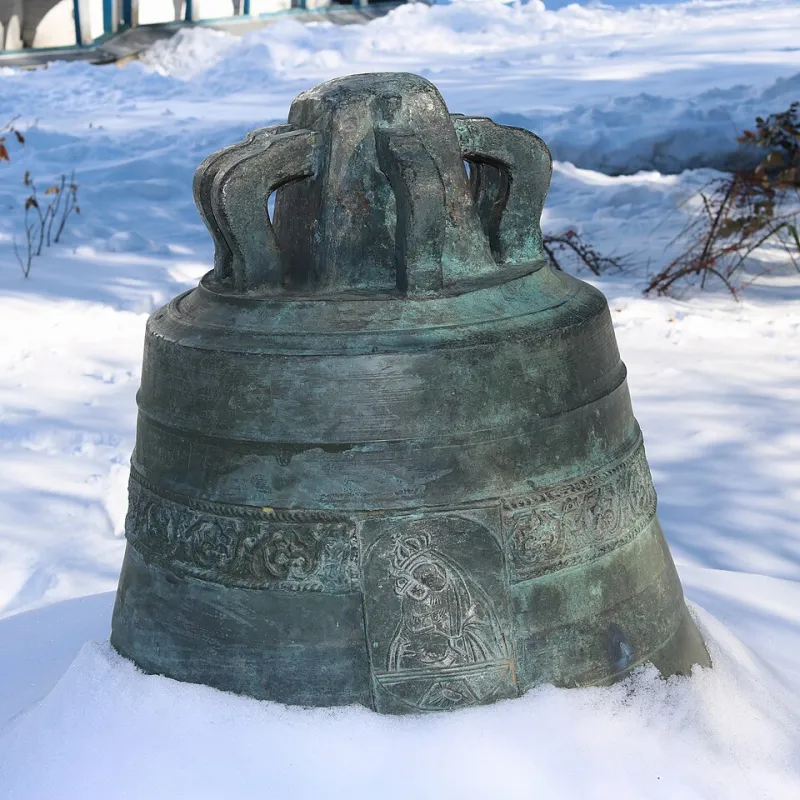
Photo: George Chernilevsky, CC BY 4.0, via Wikimedia Commons
On a damp Saturday morning in a West Country parish, the first sound from the tower is not a melody but a series of instructions. Eight ropes hang in a circle. Eight people take their places. A conductor calls a change, the bells answer, and for the next few minutes the tower becomes a workshop of ordered sound. There is no sheet music on the rope chamber wall. There is no soloist. What unfolds is change ringing, one of Britain's most distinctive living traditions and one of its least understood.
A Music Without a Melody
Change ringing is built on a simple but demanding premise. Each bell has a fixed note. The art lies not in the tune but in the order in which those notes sound. A band rings permutations of the bells, one after another, following a method rather than a melody. The result can sound to an outsider like a controlled cascade, but to a ringer it is a sequence of precise positions, each bell moving through a pattern that must be remembered, heard and corrected in real time.
The tradition took shape in England in the seventeenth century, when improvements in bell fittings made it possible to control a bell's swing with greater accuracy. From that practical advance grew a disciplined art. Rings of bells were installed in parish churches, cathedrals and municipal towers. Teams learned to ring changes, and the tower became a place of practice, instruction and quiet competition. The music was never fixed on paper in the ordinary sense. It was carried in method books, diagrams and the memory of the band.
The Method Book and the Tower Tongue
A visitor to a ringing chamber may notice a small library of pamphlets and method books. These are not scores but maps. A method such as Plain Bob Minor or Grandsire Triples is set out in lines and grids, showing where each bell should go at each change. The famous blue line in a method diagram traces the path of a single bell through the pattern. Ringers learn to read these diagrams, but they also learn to hear them. The eye and the ear must agree.
Each tower has its own vocabulary. Ringers speak of hunting, dodging, places, making the bob and going single. A conductor may call a change with a word or a gesture. Local habits of teaching and calling vary from region to region, and experienced ringers can often tell from a tower's manner of practice whether it has been shaped by a long line of local instructors. This is not folklore attached to the music; it is part of how the music is transmitted. The method book supplies the grammar. The tower supplies the accent.
The Tower as a Team
The physical demands are easy to underestimate. A bell is not played with a keyboard or a bow. It is swung by a rope, and the ringer must learn to control its momentum without forcing it. The treble, the lightest bell, and the tenor, the heaviest, require different qualities of touch. Good striking depends on every ringer listening to every other bell. A band that is slightly out of step can produce a sound that is technically correct and musically unsatisfying. A good band makes the pattern feel inevitable.
This is why change ringing is often described as a team art rather than an individual one. There is no room for the brilliant eccentric. The band must start together, change together and stop together. The conductor may be the most audible voice in the tower, but the authority of the band is shared. In an age that tends to celebrate solitary virtuosity, the ringing chamber offers a quieter model: skill exercised in service of a common pattern.
Why It Still Draws Recruits in 2026
Change ringing might appear to belong to a older Britain, but it has proved remarkably adaptable. Towers across the country hold open evenings, invite school groups and welcome visitors who have never touched a rope. Simulator software allows learners to practise patterns without disturbing neighbours. Safeguarding procedures and training schemes have been strengthened. The Central Council of Church Bell Ringers and local guilds continue to support teachers, while many bands use social media to announce practice nights and recruitment days.
The appeal is varied. Some are drawn by the mathematics, some by the sound, some by the companionship of a tower band. Others value the connection to a local building and a long civic rhythm. Ringing marks weddings, funerals, festivals and national occasions, but it also marks ordinary Tuesday evenings, when a handful of people climb a spiral stair to keep a pattern alive. In 2026, that pattern remains unwritten in the conventional sense. It is held in method books, in the memory of ringers and in the bronze itself.
At the end of the practice, the bells are set and the ropes fall still. The tower returns to silence. But the method has been rehearsed, the band has listened, and the next change is already waiting to be called.