The Lost Art of Public Discourse: Rescuing Britain's Great Lecture Tradition from Digital Oblivion
The Death of Eloquence
Something precious is dying in Britain, and we are watching it happen with the same passive resignation we once reserved for the demolition of Georgian terraces or the closure of branch railway lines. The public lecture—that cornerstone of British intellectual life for over two centuries—is withering away, starved of audiences, stripped of prestige, relegated to the margins of cultural discourse.
This is not merely the natural evolution of media consumption. It represents a fundamental shift in how we engage with ideas, how we process complex arguments, and ultimately, how we understand ourselves as thinking beings. The lecture hall, once the cathedral of British learning, has become a relic of a more patient age.
The Golden Age of Oratory
To understand what we are losing, we must remember what we once possessed. The Victorian era witnessed the apotheosis of public lecturing as both entertainment and education. John Ruskin could fill the largest halls in London with audiences hungry for his thoughts on art, society, and moral philosophy. His lectures weren't academic exercises but cultural events that shaped public opinion and individual consciousness.
 Photo: BBC Reith Lectures, via ichef.bbci.co.uk
 Photo: John Ruskin, via c8.alamy.com
Ruskin understood that the lecture was a unique art form, requiring the speaker to combine scholarly authority with theatrical presence, intellectual rigour with emotional appeal. When he spoke on 'The Political Economy of Art' or 'The Two Paths', he wasn't merely transmitting information but creating shared experiences of enlightenment.
The lecture circuit of the nineteenth century resembled nothing so much as a travelling ministry of ideas. Charles Dickens drew enormous crowds for his public readings, whilst figures like Thomas Carlyle and John Stuart Mill commanded audiences that spanned class boundaries. These events possessed a democratic quality that our current media landscape has largely lost—the immediate, unrepeatable encounter between speaker and listener, mediated by nothing but physical presence and the power of language.
The Architecture of Attention
The buildings that housed these lectures tell their own story of cultural priorities. The Royal Institution's magnificent lecture theatre, with its steep banking of seats focused on the speaker's platform, was designed to concentrate attention, to create an atmosphere of shared inquiry. Similar halls sprouted across Britain—in mechanics' institutes, literary societies, and workers' educational associations.
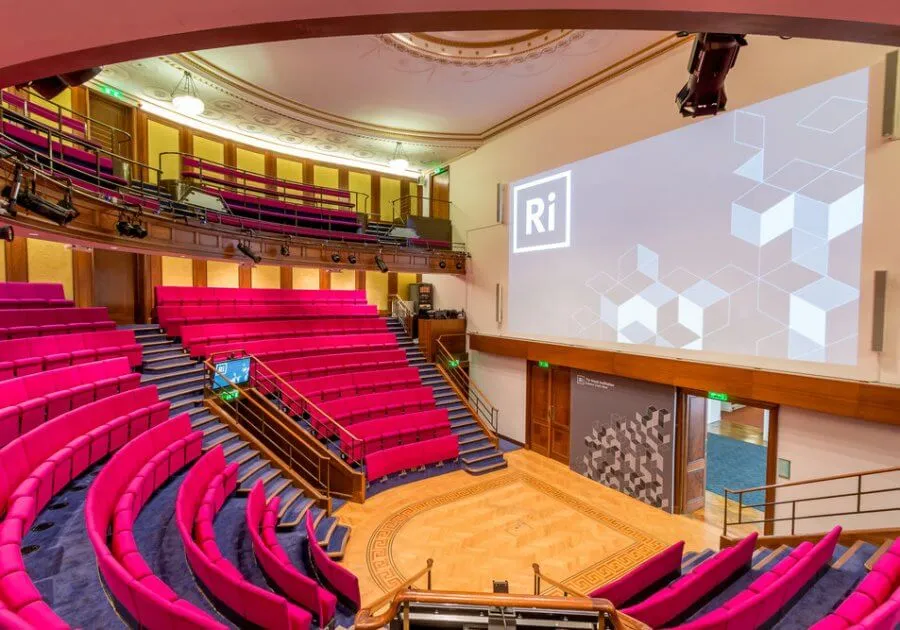 Photo: Royal Institution, via thecollectionevents.com
These spaces embodied a particular understanding of how knowledge should be transmitted and received. The lecture hall demanded sustained attention, patient listening, the willingness to follow complex arguments through to their conclusions. It was architecture designed for the cultivation of intellectual patience—a quality that seems increasingly anachronistic in our fractured digital age.
The great lecture halls also fostered a sense of community around ideas. Audiences shared the experience of grappling with difficult concepts, of being challenged and enlightened together. The post-lecture discussions that flowed through corridors and spilled into nearby coffee houses created networks of intellectual engagement that enriched entire communities.
The BBC's Noble Experiment
The twentieth century saw the lecture tradition adapt to new technologies whilst maintaining its essential character. The BBC's Reith Lectures, launched in 1948, represented perhaps the finest flowering of public discourse in the broadcast age. Named after the Corporation's first Director-General, these annual series brought the finest minds of each generation into British sitting rooms.
From Bertrand Russell's inaugural series on 'Authority and the Individual' to more recent contributions by figures like Amartya Sen and Grayson Perry, the Reith Lectures have maintained the principle that complex ideas deserve extended, uninterrupted exploration. Each lecture typically runs for forty-five minutes—an eternity by contemporary media standards, yet barely sufficient for serious intellectual work.
The Reith Lectures succeeded because they trusted their audiences. They assumed that ordinary listeners possessed the intelligence and patience to engage with challenging material, that the British public was hungry for more than entertainment. This faith was repeatedly vindicated by audience figures that regularly exceeded those for light entertainment programmes.
The Digital Fragmentation
Today's media landscape militates against everything the lecture tradition represents. Social media platforms reward brevity over depth, emotional reaction over careful consideration. The algorithmic feeds that increasingly mediate our relationship with information are optimised for engagement rather than understanding, designed to capture attention rather than sustain it.
The contemporary preference for 'bite-sized' content reflects more than changing consumer habits; it represents a fundamental shift in cognitive expectations. We are training ourselves to expect instant gratification, immediate answers, simplified explanations. The lecture's demand for intellectual patience begins to feel not merely old-fashioned but actively oppressive.
Yet this shift comes at enormous cost. Complex ideas require time to develop, nuanced arguments need space to breathe. The compression of discourse into tweet-length fragments inevitably leads to oversimplification, misunderstanding, and the triumph of rhetoric over reason.
The University's Retreat
Even within universities, the lecture faces mounting pressure. Educational theorists promote 'active learning' techniques that fragment traditional lectures into interactive segments. Whilst such approaches may have pedagogical merit, they sacrifice something essential—the sustained development of complex arguments, the modelling of serious intellectual engagement.
The traditional university lecture, at its best, was more than information transfer. It was an apprenticeship in thinking, a demonstration of how expert minds grapple with difficult problems. Students learned not just facts but intellectual habits—how to construct arguments, how to weigh evidence, how to maintain focus in the face of complexity.
The decline of lecturing skills among academics reflects broader cultural changes. Many younger scholars have never experienced the great lecturers of previous generations, have never seen how public speaking can become a form of intellectual artistry. They approach the podium as a necessary evil rather than an opportunity for scholarly performance.
The Case for Revival
Yet the lecture tradition need not become a historical curiosity. Its core principles—sustained argument, intellectual patience, the communal experience of ideas—remain as valuable as ever. Indeed, in an age of information overload and digital distraction, these qualities may be more necessary than ever.
The success of contemporary phenomena like TED Talks suggests continuing hunger for the live encounter with ideas, though these brief presentations often sacrifice depth for accessibility. The challenge lies in recovering the lecture's capacity for serious intellectual work whilst adapting to contemporary expectations.
Some institutions are pioneering new approaches that honour the lecture tradition whilst embracing modern possibilities. The Royal Institution's Friday Evening Discourses, broadcast live and available online, reach global audiences whilst maintaining the intimate atmosphere of the historic lecture theatre. Similarly, university public lecture series that combine live events with digital distribution can extend the reach of serious discourse.
The Moral Imperative
The preservation of Britain's lecture tradition is not merely a matter of cultural nostalgia. It represents a commitment to the principle that ideas matter, that complex arguments deserve serious consideration, that intellectual life requires more than the exchange of opinions in digital echo chambers.
The great lecturers of the past understood that they were not simply transmitting information but modelling ways of thinking, demonstrating the intellectual virtues that sustain civilised society. They showed their audiences how to engage with difficulty, how to suspend judgement whilst considering evidence, how to change one's mind in response to better arguments.
These skills have never been more urgently needed. In an era of post-truth politics and algorithmic manipulation, the ability to follow sustained arguments and evaluate complex evidence becomes a form of civic defence. The lecture hall, properly understood, is not an antiquated institution but a gymnasium for democratic citizenship.
The Spring of Renewal
Britain's cultural spring requires more than the preservation of buildings and archives; it demands the revival of living traditions that connect past wisdom with present needs. The lecture tradition, properly renewed, could serve as a bridge between the patient scholarship of previous generations and the urgent intellectual challenges of our own time.
This revival will require commitment from institutions, speakers, and audiences alike. Universities must recognise that lecturing is not an obsolete pedagogical method but a vital cultural practice. Broadcasters must resist the temptation to fragment serious discourse into digestible segments. And audiences must rediscover the pleasures of intellectual patience, the satisfaction of following complex arguments to their conclusions.
The lecture tradition built Britain's intellectual culture. Its restoration may be essential to that culture's survival. In an age of digital distraction and shortened attention spans, the ancient art of sustained public discourse offers not escape from modernity but the tools to master it. The question is not whether we can afford to preserve this tradition, but whether we can afford to lose it.