Inscribed in Silence: What Britain's Literary Dedications Reveal About the Hidden Lives of Great Authors
The Most Overlooked Lines in Literature
There is a page in almost every book that the reader passes through without pausing: the dedication. Positioned between the title page and the opening chapter, it occupies a liminal space — formally part of the work yet seemingly external to it, personal in tone yet published for all the world to read. Most readers treat it as a form of domestic notice, of interest perhaps to the dedicatee but of little consequence to anyone else. This is a serious misreading. The literary dedication, practised with craft and intention, is one of the richest documentary sources we possess for understanding the social and artistic networks that shaped British literature across four centuries.
To read the dedications of Britain's greatest authors with proper attention is to enter a world of extraordinary complexity: of strategic alliances and coded affections, of public gratitude concealing private anguish, of literary feuds conducted in the most exquisitely polished of terms. These few lines, so easily skipped, repay scrutiny more generously than almost any other element of the books in which they appear.
The Patron, the Prince, and the Politic Gesture
The dedication has its origins in the economics of early modern publishing, when writers depended upon the goodwill of wealthy patrons to subsidise their work. The Renaissance dedication was frequently a piece of elaborate flattery, designed to secure financial support or political protection. Edmund Spenser's dedication of The Faerie Queene to Queen Elizabeth I in 1590 is perhaps the most magnificent example in the English tradition: a calculated act of homage that simultaneously served the poet's material interests and participated in the wider cultural project of constructing an Elizabethan mythology.
By the nineteenth century, the commercial conditions of authorship had altered considerably, yet the dedication retained its capacity for strategic deployment. Jane Austen's decision to dedicate Emma (1815) to the Prince Regent — a man for whom she entertained, by her own private admission, feelings of considerable contempt — is frequently cited as an example of authorial pragmatism overcoming personal distaste. The dedication had been suggested, with some insistence, by the Prince's librarian, James Stanier Clarke, during a visit Austen made to Carlton House. To refuse would have been professionally imprudent. The dedication she produced is a masterpiece of formal correctness that contrives, through its very perfection of courtesy, to say almost nothing at all.
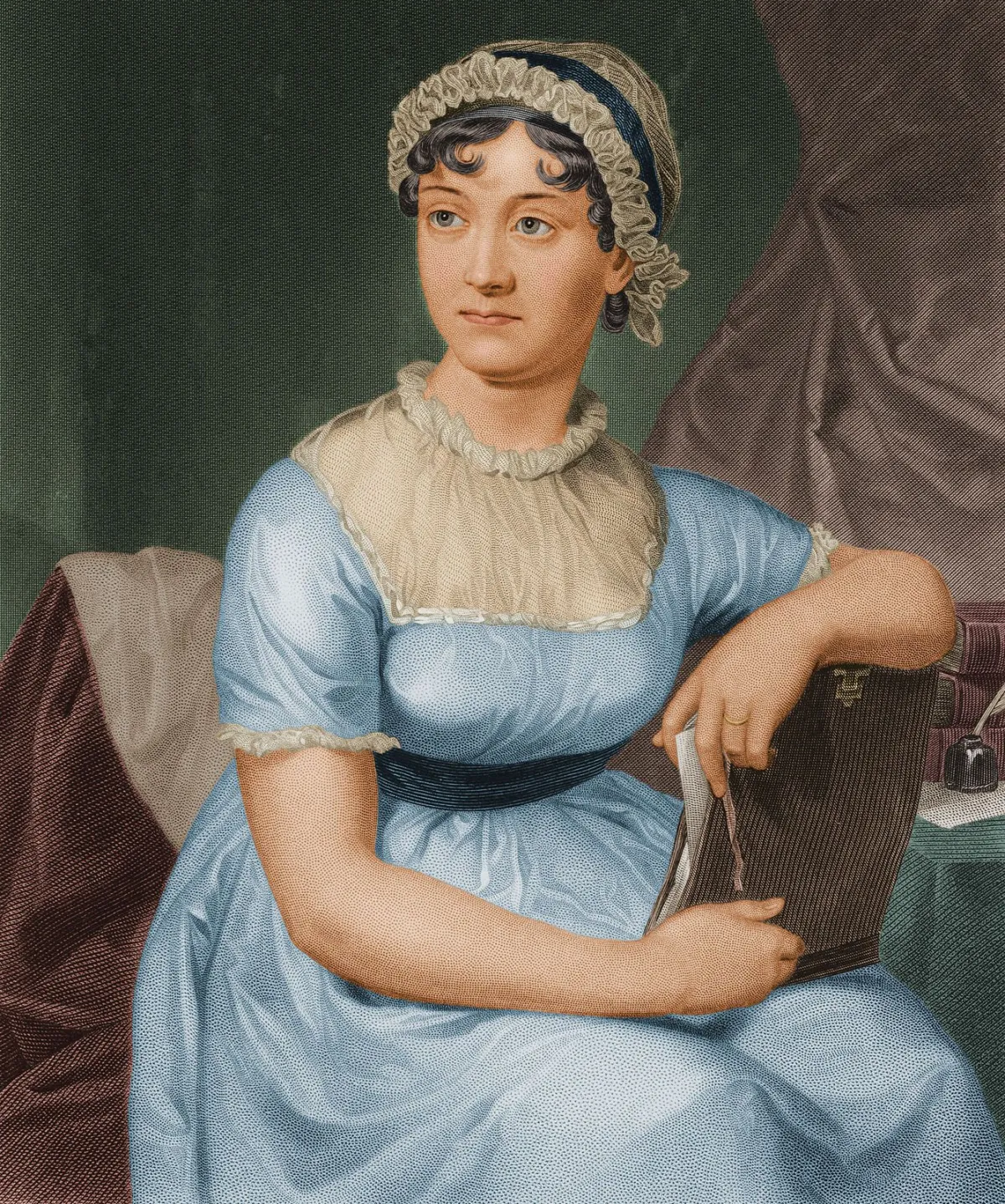 Photo: Jane Austen, via cdn.britannica.com
This episode illuminates something important about the dedication as a form: it operates simultaneously in the public and private registers, and the gap between those registers is frequently where its most interesting meanings reside.
Grief, Love, and the Unspeakable
If strategic dedications reveal the social pressures under which authors worked, the more intimate variety discloses something altogether more affecting. Some of the most moving dedications in British literary history are those in which grief or love, too large for direct expression, finds its outlet in the formal constraint of a few chosen words.
Charles Dickens's dedication of Dombey and Son (1848) to the Marchioness of Normanby is unremarkable in itself. But the dedication he composed for The Old Curiosity Shop — effectively a memorial to the child-character Little Nell, who was widely understood to embody the memory of his deceased sister-in-law Mary Hogarth — encodes a depth of private mourning within a public form that the novel's sentimental excesses, for all their contemporary popularity, cannot quite match. The restraint of the dedication intensifies what the novel itself labours to express.
Thomas Hardy, whose emotional life was conducted largely in the private registers of poetry and correspondence, produced dedications of remarkable compression. The dedication of Far From the Madding Crowd to his first wife Emma, composed in happier times, acquires, when read against the bitter poetry of Poems of 1912–13, a retrospective poignancy that Hardy himself could not have anticipated. The dedication becomes, in such cases, a palimpsest: innocent in its original context, devastating in the light of subsequent knowledge.
Modernism and the Coded Inscription
The modernist period produced a new variety of literary dedication, characterised by a self-conscious awareness of the form's possibilities and a corresponding tendency to exploit them. T.S. Eliot's dedication of The Waste Land (1922) to Ezra Pound — 'il miglior fabbro,' the better craftsman, a phrase borrowed from Dante — is an act of homage that simultaneously acknowledges an artistic debt and positions both men within a tradition of elevated European literary ambition. It is a dedication that makes an argument about literary history in the space of three words.
Virginia Woolf's dedications are characteristically oblique. To the Lighthouse (1927), dedicated simply 'To V.S.,' gestures towards Vita Sackville-West with a discretion that the period's social codes demanded but that the novel's emotional textures render almost transparent. The dedication functions as a private signal within a public document, comprehensible to those who knew and encrypted against those who did not. It is, in miniature, an emblem of the double life that many writers of Woolf's generation were compelled to maintain.
The Decline of the Considered Dedication
It would be unjust to suggest that the literary dedication has entirely vanished from contemporary British publishing. Authors continue to dedicate their books to family members, friends, and colleagues, and occasional examples of genuine wit or emotional precision still appear. But the considered, crafted dedication — the kind that participates in the work's meaning, that encodes the author's social and artistic position, that repays the attentive reader's scrutiny — has become markedly rarer.
Several factors have contributed to this decline. The collapse of the patron-client relationship, already long advanced by the twentieth century, removed the political and economic pressures that once made the dedication a matter of some consequence. The informality of contemporary publishing culture, with its emphasis on accessibility and its suspicion of anything that might seem precious or arcane, has made the elaborate dedication feel anachronistic. And the rise of the acknowledgements section — that sprawling, democratic, frequently exhausting catalogue of gratitude that now occupies several pages in most literary novels — has displaced the dedication's function without replicating its economy or its art.
The acknowledgements page tells us, in considerable detail, who helped the author write the book. The dedication, at its finest, tells us something about who the author was.
Reading Between the Lines
There is a case to be made — and it is not a merely nostalgic one — that the literary dedication, properly attended to, constitutes a minor art form of considerable distinction. It demands of the writer the discipline of extreme compression, the courage of public declaration, and the skill to calibrate the relationship between the private and the public in a form that must serve both simultaneously.
For the reader, it offers something that the digitised, hyperlinked, instantly searchable text of contemporary publishing tends to dissolve: a moment of genuine pause before the work begins. A dedication asks the reader to consider, however briefly, that the book they are about to read was made by a particular human being, in particular circumstances, for reasons that exceeded the merely commercial. In that pause, if we choose to take it, a great deal of British literary history becomes quietly, compellingly audible.