Five Bandstands Still Keeping Britain's Summers Musical
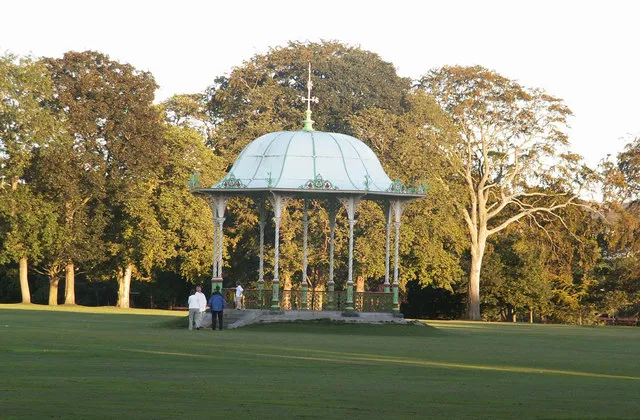
Photo: pamela, CC BY-SA 2.0, via Wikimedia Commons
The bandstand is one of Britain's most modest architectural gifts to public life. A raised platform, a decorative roof, a few steps and a circle of benches: the formula has hardly changed since the Victorian heyday of municipal parks. Yet the bandstand was never merely a shelter for musicians. It was a statement of civic idealism, a belief that good music should be within reach of anyone who chose to walk through the park gates. In 2026, that belief survives in a number of bandstands that remain active stages for brass, wind and community music.
Eastbourne Bandstand, East Sussex
On the seafront at Eastbourne, the bandstand is less a park ornament than a seaside institution. Its curved white form faces the promenade and the sea, and its summer programme has long mixed brass bands, light music and popular entertainment. The present structure dates from the 1930s, but it inherits the Victorian conviction that a resort should offer culture as well as air. Local audiences and holidaymakers still gather under its canopy, and the sound of a band carrying across the promenade remains one of the town's defining pleasures. Maintaining a seaside bandstand is expensive work, and the local authority and its partners have had to balance heritage with the practical demands of weather, safety and programming. The result is a stage that feels both nostalgic and alive.
Southsea Bandstand, Portsmouth
Southsea's bandstand sits in the long civic landscape of Portsmouth's seafront, where promenade, park and sea meet. It has become a regular summer stage for community groups, brass bands and informal concerts, often with free or low-cost admission. The atmosphere is less formal than a concert hall and more sociable than a recital room: families pause, cyclists slow down and listeners drift in and out. That accessibility is precisely the point. The bandstand tradition was built on the idea that music could be part of a day out rather than a separate expedition. Volunteers and local organisers play a crucial role in keeping the programme varied, and the bandstand continues to function as a meeting point for the city's musical life.
Sheffield Botanical Gardens Bandstand
In Sheffield, the bandstand in the Botanical Gardens offers a greener, more enclosed version of the same civic ideal. The gardens themselves are a Victorian creation, and the bandstand provides a natural focal point for summer music. Brass bands, wind ensembles and community choirs use the space, drawing audiences who may have come for the gardens and stay for the sound. The setting changes the experience: trees soften the acoustic, birdsong sometimes competes with the music, and the audience sits in a loose semicircle rather than a disciplined row. Local trusts and friends' groups have long recognised that a bandstand is only as alive as its programme. By supporting performances and maintenance, they help preserve not just a structure but a habit of public listening.
Roath Park Bandstand, Cardiff
Roath Park in Cardiff is one of the city's great Victorian public landscapes, and its bandstand reflects the same period's faith in parks as places of improvement and pleasure. Summer concerts here have a relaxed, local character, with community bands and family audiences sharing the same space. The bandstand is not a museum piece; it is a working stage, and its survival depends on the care of the park and the goodwill of performers and volunteers. In a city with a strong brass band tradition, the open-air platform offers a way for that tradition to remain visible and audible. The audience may be smaller than at a formal concert, but the principle is the same: music belongs to the public realm.
Kelvingrove Bandstand, Glasgow
Glasgow's Kelvingrove Bandstand, set within Kelvingrove Park, has enjoyed a notable revival in recent years. Restored and reopened as a performance venue, it now hosts a mixture of community events, concerts and cultural programming. The bandstand's structure gives it a distinctive presence: a circular stage under a domed roof, surrounded by parkland and the life of the city. Its revival illustrates what can happen when local authorities, trusts and audiences recognise the value of a neglected civic asset. The programme is broader than the Victorian brass band repertoire, but the underlying idea remains. A bandstand is a place where music meets the ordinary life of a city, without the barriers of a ticket hall or a formal dress code.
A Civic Tradition Worth Keeping
These five bandstands are not identical. One faces the sea, another sits among botanical beds, another has been revived as a contemporary venue. What unites them is a stubbornly democratic idea of music. The Victorian bandstand was never simply about architecture. It was about making culture part of the everyday landscape, available to those who might never enter a concert hall. In 2026, that idea still works. It works when a volunteer arranges a summer season, when a local band sets up its music stands, when an audience settles on a bench with an ice cream and listens for an hour. The bandstand remains a small stage with a large civic purpose, and Britain's summers are the better for it.