Worlds Built by Hand: The Scenic Artists Who Made British Theatre Magnificent
The Invisible Architects
When a Victorian audience gasped at the moonlit harbour revealed as the curtain rose on a new production at Drury Lane, the credit in their minds belonged — if it belonged to anyone specific — to the actor-manager whose name blazed above the door. The scene painter who had spent weeks at the top of a swaying paint frame, executing an image of breathtaking delicacy on a canvas measuring forty feet in height, remained, in the public imagination, an anonymous artisan: skilled, certainly, but not an artist in the sense that the word was then understood.
This injustice has been only partially corrected by subsequent scholarship, and the scenic tradition it obscures remains one of the least appreciated chapters in the history of British cultural life. The scenic artists of the Victorian and Edwardian theatre were, by any serious measure, painters of considerable accomplishment working in a medium that demanded not merely technical virtuosity but an understanding of theatrical light, spatial illusion, and audience psychology that no easel painter was required to possess.
The Victorian Spectacular and Its Masters
The dominant mode of Victorian theatrical production was the spectacular — a form that placed the visual experience of performance at its very centre and that consequently elevated the scene painter to a position of genuine creative importance, even if that importance was rarely acknowledged in terms of billing or remuneration.
The most celebrated scenic artists of the mid-Victorian period — among them William Telbin, Thomas Grieve, and the members of the extraordinary Lloyds dynasty of scene painters — worked at a scale and with an ambition that had no parallel in the gallery art of their time. Their canvases were not merely large; they were designed to be experienced in motion, in the flickering light of gas and later electricity, as part of a kinetic whole that included the movement of actors, the sound of an orchestra, and the responsive presence of an audience.
Telbin's work for the productions of Charles Kean at the Princess's Theatre in the 1850s represents perhaps the high-water mark of Victorian scenic ambition. Kean's celebrated Shakespeare revivals — productions of Richard II, The Winter's Tale, and A Midsummer Night's Dream that were as much visual spectacles as theatrical experiences — depended upon scenic paintings of extraordinary archaeological precision. Telbin and his collaborators researched their subjects with a rigour that would have been recognisable to any serious Victorian historian, producing images of medieval England and classical antiquity that were simultaneously historically informed and theatrically transcendent.
Opera and the Grandest Canvas
If the legitimate theatre provided the scenic artist with considerable scope, the opera house offered something approaching limitlessness. The demands of grand opera — its requirement for settings of palatial grandeur, supernatural transformation, and elemental natural power — pushed scenic painting to the outermost boundaries of its technical possibilities.
Covent Garden, throughout the nineteenth and early twentieth centuries, maintained a studio of scene painters whose output was prodigious and whose standards were, at their finest, equal to anything produced on the operatic stages of Paris or Vienna. The productions mounted for the great visiting singers of the era — Patti, Melba, Caruso — were surrounded by visual environments that audiences regarded as integral to the total experience of the work, not as mere backdrop to vocal performance.
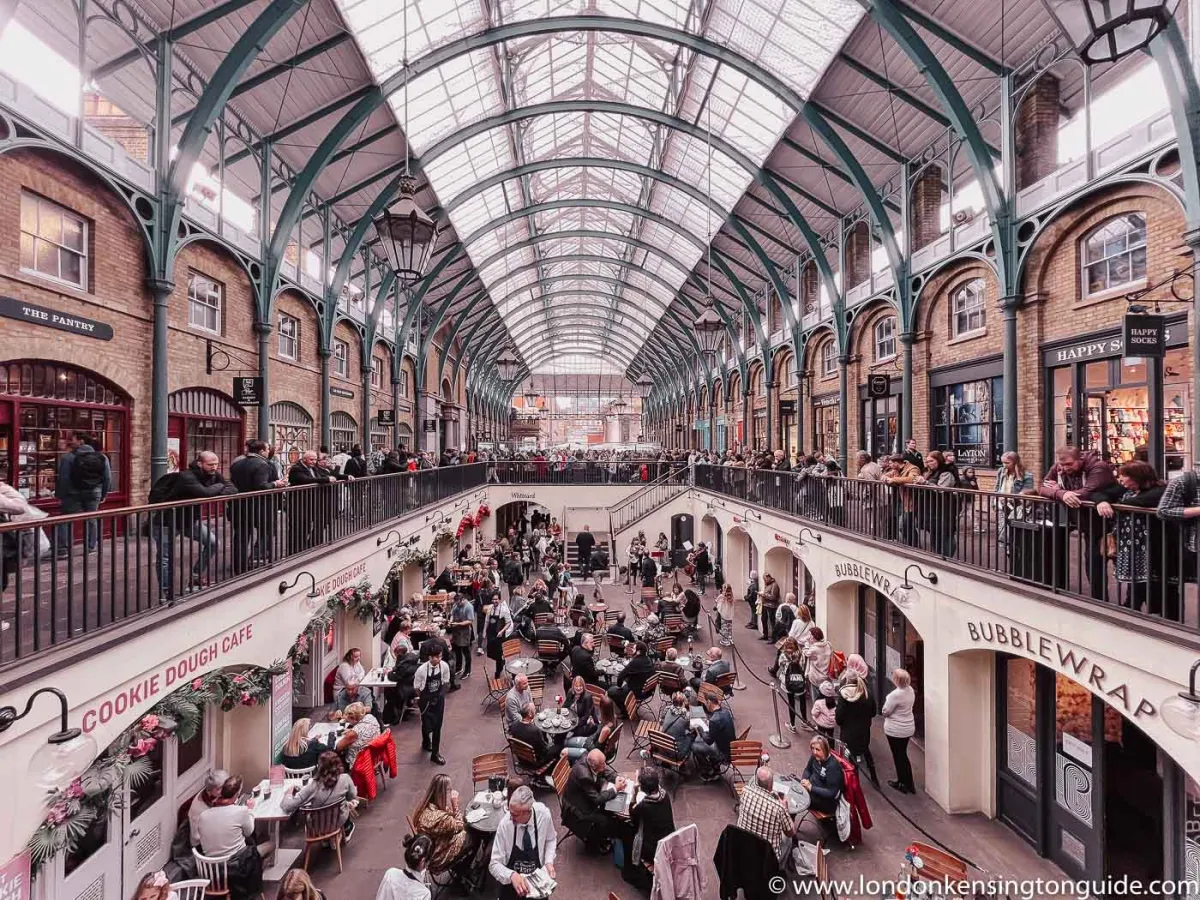 Photo: Covent Garden, via www.londonkensingtonguide.com
The operatic scenic tradition produced figures of genuine artistic distinction, among them the painter and designer Joseph Harker, whose work for Covent Garden and the touring productions of the late Victorian era demonstrated that the scene painter could aspire to something beyond mere illustration — could, in fact, achieve effects of genuine pictorial poetry within the demanding constraints of the theatrical frame.
The Twentieth Century and Its Reinventions
The arrival of the twentieth century brought with it a revolution in theatrical thinking that posed an existential challenge to the scenic painting tradition. The influence of Edward Gordon Craig — whose visionary writings on theatrical design argued for the replacement of illusionistic scenery with abstract, architecturally conceived space — created an intellectual climate in which the painted canvas began to seem not merely old-fashioned but philosophically suspect.
Yet the response of Britain's most gifted scenic artists to this challenge was not capitulation but adaptation. Figures such as Rex Whistler, whose work for productions at the Sadler's Wells Ballet in the 1930s demonstrated that the painterly tradition could encompass modernist sensibility without abandoning its essential character, and later Leslie Hurry, whose extraordinary designs for the Old Vic and Covent Garden in the 1940s and 1950s brought a romantic expressionism to the operatic stage, showed that the craft was capable of renewal rather than mere survival.
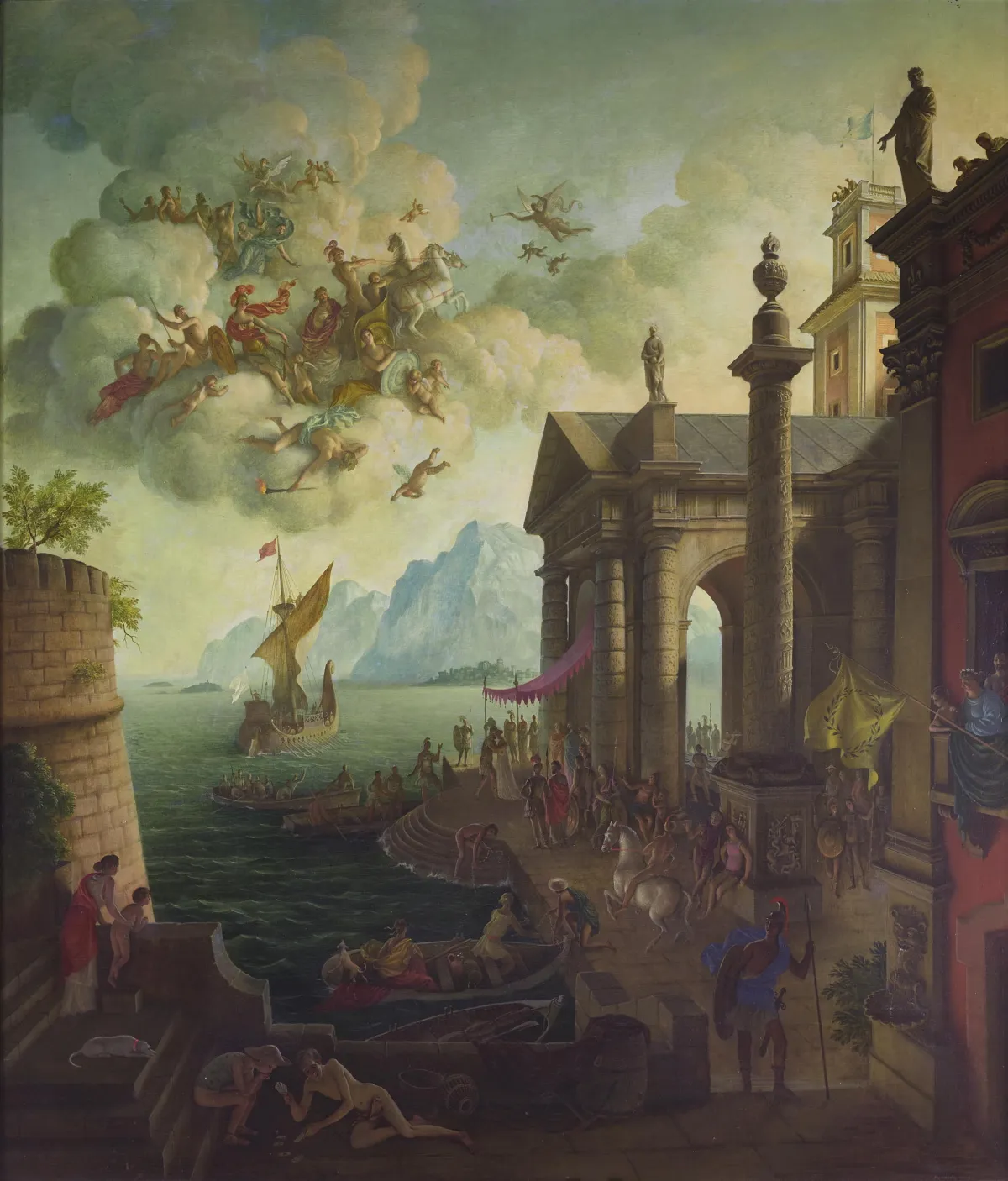 Photo: Rex Whistler, via cdn.mos.cms.futurecdn.net
Hurry's designs for the Old Vic's Hamlet of 1944 — featuring a brooding, vertiginous castle interior that seemed to embody the psychological landscape of the play as much as its physical setting — are among the finest examples of mid-century British theatrical design. They demonstrate, with particular clarity, how the best scenic artists worked not as decorators of theatrical space but as interpreters of dramatic meaning.
Surviving Examples and the Fragile Tradition
The physical survival of scenic art presents particular challenges. Unlike an easel painting, a theatrical canvas was designed for repeated use and eventual disposal; the economics of theatrical production were rarely sympathetic to the long-term preservation of scenic materials. Yet a number of significant collections have survived, held by institutions including the Victoria and Albert Museum's Theatre and Performance archive, the Bristol Old Vic, and several regional repertory theatres whose historic stockrooms have occasionally yielded remarkable discoveries.
The tradition of hand-painted scenery has not entirely perished, though it persists against considerable pressure from the expanding capabilities of digital projection, which offers theatre producers effects of comparable visual impact at a fraction of the labour cost. A small number of scenic studios continue to operate in Britain — most notably those associated with the major opera houses — maintaining skills and techniques whose lineage extends directly to the Victorian masters.
The case for preserving this tradition rests not merely on sentiment or historical loyalty. Hand-painted scenery possesses qualities — a warmth, a textural complexity, a responsiveness to theatrical light — that digital projection cannot replicate, and that audiences, even those without specialist knowledge, instinctively perceive. The worlds built by hand carry within them the evidence of human making, and it is precisely that evidence which gives them their peculiar power to move.