Grand Arrivals: The Victorian Railway Hotels That Quietly Became Britain's Cultural Crossroads
Grand Arrivals: The Victorian Railway Hotels That Quietly Became Britain's Cultural Crossroads
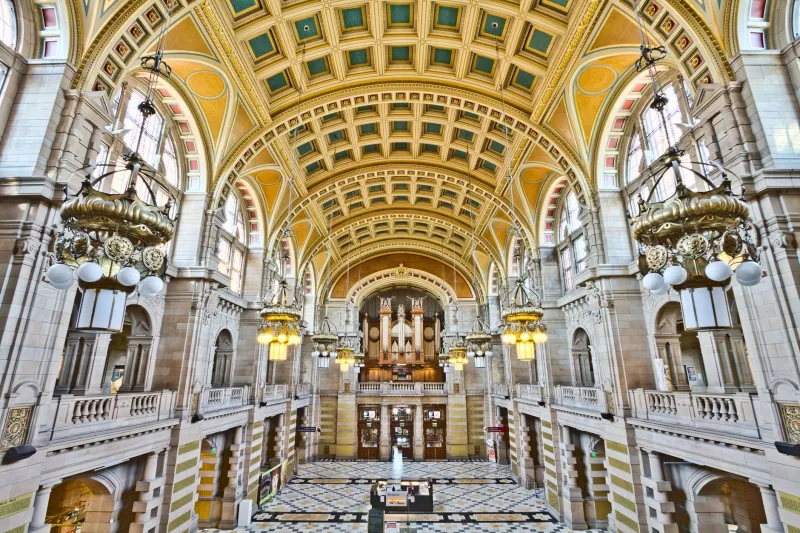
There is a particular quality of grandeur to Britain's surviving railway hotels that no amount of subsequent renovation has entirely erased. Stand in the vaulted Gothic hallways of the Midland Grand at St Pancras, or beneath the baronial stonework of the North British in Edinburgh, and one senses that these buildings were always intended to be something more than convenient lodgings for the travelling public. They were statements — of civic pride, of commercial ambition, and, as it transpired, of cultural aspiration.
 Photo: Midland Grand at St Pancras, via pbs.twimg.com
For much of the Victorian and Edwardian era, these hotels occupied a unique position in British social life. Situated at the precise intersection of mobility and respectability, they attracted a clientele that was newly prosperous, often cultured, and frequently in search of sophisticated entertainment far from home. The railway companies, with characteristic Victorian pragmatism, were only too pleased to oblige.
Architecture as Invitation
The great railway hotels were not designed merely to impress; they were designed to persuade. Their architects — George Gilbert Scott at St Pancras, William Hamilton Beattie in Edinburgh, Alfred Waterhouse at the Metropole in Manchester — understood that grandeur was itself a form of cultural argument. Soaring ceilings, ornate plasterwork, and generously proportioned public rooms created spaces that seemed to demand a particular quality of behaviour from those who inhabited them. Conversation, music, and literary discourse felt not merely appropriate but almost obligatory.
This was no accident. The railway companies that commissioned these buildings were acutely conscious of their public image, and several invested deliberately in cultural programming as a means of elevating their brand above mere transport. The dining rooms and drawing rooms of their flagship hotels were frequently made available for recitals, readings, and chamber concerts — events that attracted local society as readily as they served the hotel's residential guests.
Platforms for Performance
Surviving concert programmes from the late nineteenth century offer a vivid portrait of the musical life that flourished within these walls. At the Great Central Hotel in Marylebone — completed in 1899 to serve the last mainline terminus built in Victorian London — regular Wednesday evening recitals drew audiences of considerable sophistication. Programmes from the early 1900s, preserved in the collections of the British Library, reveal performances of Schumann, Brahms, and Fauré presented in a room that could seat nearly two hundred guests.
 Photo: Great Central Hotel in Marylebone, via rajon-avocats.com
The North British Hotel in Edinburgh, which opened in 1902 at the head of Waverley Station, developed an especially distinguished cultural identity. Its proximity to the Edinburgh establishment — legal, ecclesiastical, and academic — ensured that its public rooms attracted precisely the sort of audience that expected intellectual and artistic stimulation alongside dinner. Chamber music evenings became a regular feature of its social calendar, and surviving correspondence suggests that several Scottish composers of the period considered the hotel's drawing room a more reliable venue for new work than many of the city's dedicated concert halls.
Further north, the Station Hotel in Inverness — a considerably less ornate establishment but no less significant in its regional context — hosted literary evenings that brought together the scattered intellectual life of the Highlands in a manner that would otherwise have been impossible. The railway had, after all, made the Highlands newly accessible, and the hotel that served as the gateway to that landscape became a natural gathering point for writers and musicians exploring a region that was itself undergoing a cultural renaissance.
The Mobile Audience and Its Demands
What distinguished the railway hotel audience from those attending established concert halls and theatres was, above all, its mobility. These were people in transit — commercial travellers of the better sort, professional men visiting clients, families relocating, tourists pursuing the newly fashionable pastime of touring Britain by rail. They brought with them the cultural expectations of their home cities and a readiness to be entertained that permanent residents, dulled by familiarity, sometimes lacked.
This created a remarkably receptive environment for classical performance. A pianist performing Chopin in the lounge of the Adelphi Hotel in Liverpool on a Tuesday evening in 1895 could expect an audience drawn from Birmingham, Glasgow, and London, each member carrying their own cultural frame of reference and bringing to the occasion a quality of attentive appreciation that a local audience, accustomed to the same performer at the same venue, might not always provide.
The hotel managements understood this dynamic and exploited it thoughtfully. Several employed resident musicians of genuine accomplishment — not merely as background entertainment but as performers capable of anchoring a proper recital programme. The Grosvenor Hotel at Victoria, conveniently positioned for travellers departing to the Continent, was particularly noted in the 1880s and 1890s for the quality of its resident string quartet, whose Sunday afternoon concerts attracted a following that extended well beyond the hotel's guests.
Literary Gatherings and the Spoken Word
Music was not the only art form that found a home within these grand interiors. Literary gatherings, public readings, and lecture evenings were a regular feature of the cultural programming offered by several of Britain's larger railway hotels. The tradition of the public lecture, which had flourished in mechanics' institutes and learned societies throughout the Victorian period, found a natural second home in the spacious, well-heated public rooms of the railway hotel.
At the Queen's Hotel in Leeds — for decades the social centrepiece of a city that prided itself on its cultural ambitions — readings from contemporary literature were a staple of the winter social season. Local literary societies frequently hired the hotel's public rooms for their gatherings, and the mingling of resident guests with local members created precisely the kind of cross-pollination between travelling and settled culture that the railway age made newly possible.
The Tregenna Castle Hotel in St Ives, converted from an earlier house by the Great Western Railway in the 1870s, occupies a particularly interesting position in this story. Its location in a town that would later become synonymous with British modernist art meant that its public rooms hosted conversations and informal gatherings that bridged the Victorian cultural world and the twentieth-century avant-garde. Several members of the Newlyn and St Ives artistic circles are known to have used the hotel as a meeting place, its railway connections making it a convenient point of arrival for visitors from London and beyond.
A Legacy Worth Reclaiming
Many of Britain's great railway hotels have survived, though not always in forms their original architects would recognise. The Midland Grand at St Pancras, restored to extraordinary magnificence and reopened as a luxury hotel in 2011, has made conscious efforts to honour its cultural heritage through a programme of events that echoes, however distantly, the recitals and gatherings of its Victorian prime. The North British, now trading under a different name, retains much of its original splendour and continues to serve as a gathering point for Edinburgh's cultural life.
What deserves greater recognition is the broader story these buildings represent — a story in which commerce and culture proved not merely compatible but genuinely symbiotic. The railway companies that built these extraordinary hotels were motivated by profit, but in creating spaces of genuine architectural distinction and making them available for artistic purposes, they contributed something lasting and rather beautiful to the cultural fabric of Britain. The stage they offered was borrowed, certainly — borrowed from commerce, from ambition, from the restless energy of a nation on the move. But the performances it hosted were entirely, magnificently real.