When the Towns Held Festivals: The Lost Cultural Gatherings of Britain's Golden Summer
When the Towns Held Festivals: The Lost Cultural Gatherings of Britain's Golden Summer
There was a time, not so very distant in historical terms, when the cultural calendar of provincial Britain was marked not by what London offered, but by what a town offered itself. From the industrial heartlands of the Midlands to the cathedral cities of the south, and from the mill towns of Yorkshire to the market centres of East Anglia, the summer and autumn months were defined by festivals of music, literature, and the performing arts that drew audiences of thousands and commanded national attention.
These were not modest affairs. They were occasions of civic pride, artistic ambition, and communal celebration — events at which new works were premiered, great soloists performed, and the cultural life of a nation was, for a few extraordinary days, distributed across its geography rather than concentrated in the capital. Their loss is among the quieter cultural tragedies of the twentieth century.
The Age of the Provincial Festival
The great age of the British regional festival roughly spans the 1830s to the 1930s, though its roots reach deeper and its afterglow lingered longer in certain places. The model was, in part, inherited from the grand Three Choirs Festival — the extraordinary rotating gathering hosted by the cathedral cities of Gloucester, Worcester, and Hereford, which survives to this day and represents the living memory of what once flourished far more widely.
But the Three Choirs was exceptional in its longevity. Dozens of comparable festivals rose and fell across the same period, each shaped by the particular character of its host community and the ambitions of the local worthies who funded and organised them.
The Birmingham Triennial Music Festival, founded in 1768 and held in its grandest form throughout the Victorian era, was among the most prestigious musical events in Europe during its prime. Handel's works formed its early backbone, but by the mid-nineteenth century it had become a platform for new British composition of the highest order. Elgar's The Dream of Gerontius received its troubled world première at the Birmingham Festival in 1900 — an event that, despite a performance widely considered inadequate at the time, would eventually be recognised as one of the defining moments in British musical history.
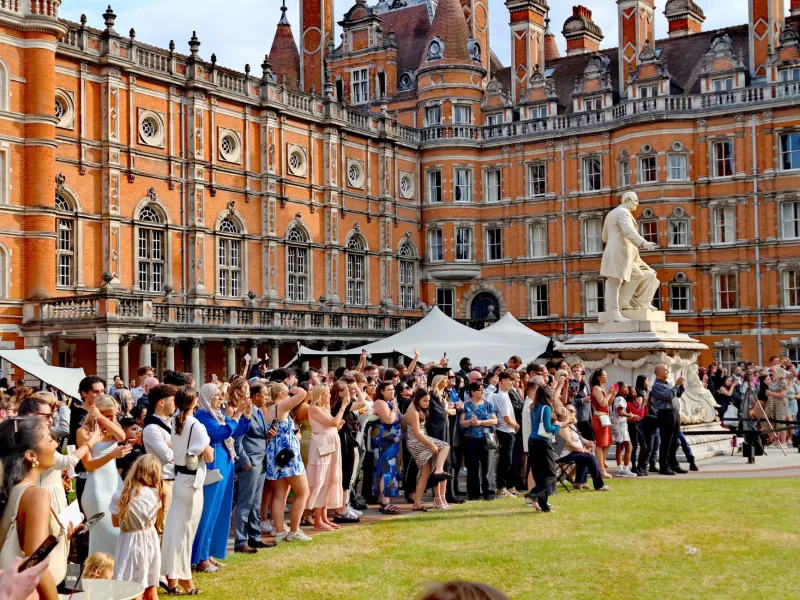
 Photo: Birmingham Triennial Music Festival, via offloadmedia.feverup.com
The festival endured until 1912, its final edition. The combination of changing tastes, the growing dominance of London's concert life, and the financial pressures that would soon be catastrophically compounded by the First World War proved insurmountable. Birmingham lost something it has never quite recovered.
Norwich and the Spirit of the East
Further east, the Norwich Musical Festival had been illuminating the cultural life of East Anglia since 1824. Held in St Andrew's Hall — a magnificent medieval building that had once served as the nave of a Dominican priory — the festival drew performers and audiences from across the country. Jenny Lind, the celebrated Swedish soprano known as the "Swedish Nightingale," performed there in the mid-nineteenth century to rapturous reception. Clara Schumann appeared on its platform. The event was, by any measure, a gathering of European cultural significance hosted in a provincial English city.
 Photo: St Andrew's Hall, via a.vsstatic.com
The Norwich Festival declined through the early twentieth century and eventually ceased, a casualty of economic pressures and the centralising tendency that drew artistic talent and patronage ever more firmly towards London. St Andrew's Hall still stands, still hosts concerts, but the grand festival atmosphere — that sense of a community gathering in shared artistic purpose over several days — has not been recreated.
The Hanley Festival and the Potteries' Ambition
Perhaps the most poignant of the lost festivals is one that has been almost entirely forgotten outside specialist circles: the North Staffordshire District Choral Society's festival, held in the Potteries towns of the late Victorian and Edwardian eras. In a region better known for its ceramics industry than its cultural life, this gathering represented an extraordinary act of civic aspiration.
The working communities of the Five Towns — immortalised in Arnold Bennett's fiction — poured genuine passion into their choral tradition. The festivals they organised were not pale imitations of metropolitan taste; they were expressions of a deep and authentic musical culture rooted in the chapel tradition and the communal singing that had long defined the social fabric of nonconformist England. When industrial decline eroded the economic foundations of these communities, the festivals went with them.
Why They Fell Silent
The causes of decline were rarely singular. The First World War devastated the social structures that had sustained these events — the networks of patrons, the volunteer committees, the expectation of communal participation in cultural life that had been a defining feature of Victorian civic identity. The interwar period saw some festivals attempt revival, but the economic crises of the 1920s and 1930s, followed swiftly by another world war, proved too great an obstacle for most.
The BBC's growing dominance of British musical life from the 1920s onwards also played a significant, if less acknowledged, role. When the finest orchestras and soloists could be heard in the home, the incentive to travel to a provincial festival and invest in expensive tickets diminished. The democratisation of musical access, for all its benefits, came at a cost to the communal experience that festivals uniquely provided.
Post-war arts policy, channelled increasingly through the newly established Arts Council, tended to favour permanent institutions — orchestras, opera companies, theatres — over periodic festivals rooted in specific communities. Funding flowed to London and to a handful of prestige regional centres. The smaller, place-specific festival culture that had flourished in Victorian Britain received little institutional support.
Surviving Echoes and Living Comparisons
To understand what was lost, one need only look at what survives. The Cheltenham Music Festival, founded in 1945, and the Aldeburgh Festival, established by Benjamin Britten and Peter Pears in 1948, both demonstrate the irreplaceable value of a festival deeply rooted in its particular place and community. Aldeburgh in particular — held in the small Suffolk coastal town where Britten lived and worked — has maintained a creative identity that no metropolitan event could replicate. Its intimacy, its sense of artistic purpose, and its relationship to a specific landscape and community are precisely the qualities that defined the great provincial festivals of the previous century.
The Hay Festival, though primarily literary rather than musical, offers another model: an event that has transformed a small Welsh border town into an internationally recognised gathering place for ideas, and in doing so has demonstrated the transformative power of cultural ambition at a local level.
A Case for Revival
The question of whether any of Britain's lost festivals could or should be revived is not merely sentimental. In an era when regional identity is being reasserted with new confidence, and when the cultural case for decentralisation has never been stronger, the festival model has genuine contemporary relevance.
Several smaller-scale initiatives in recent years have pointed towards the possibilities: locally organised summer gatherings in historic venues, community choral festivals rooted in particular traditions, literary weekends that draw on the specific character of their host towns. None has yet achieved the scale or prestige of the great Victorian events, but the appetite is demonstrably present.
What is required is not nostalgia, but vision — the willingness to imagine that a town or city might once again place cultural ambition at the heart of its public identity, and that a festival might be the means by which that ambition finds its fullest and most joyful expression. Britain's golden summers of communal celebration are not, perhaps, as irretrievably lost as they sometimes seem.