Sacred Sounds Under Siege: The Quiet Crisis Threatening England's Ancient Bell Towers
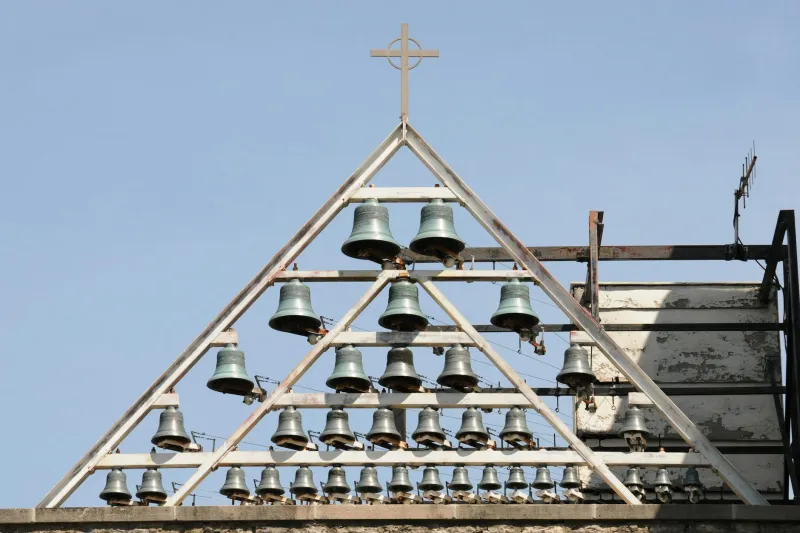
The Mathematics of Medieval Music
Every Sunday morning across England, a sound echoes that has remained fundamentally unchanged for over four centuries. The complex mathematical patterns of change ringing—where bells are rung in constantly varying sequences—represent one of Europe's most sophisticated musical traditions. Yet this uniquely English art form, which once summoned entire communities to worship and celebration, now faces a demographic crisis that threatens its very survival.
England possesses approximately 5,000 rings of bells capable of change ringing, representing nearly half the world's total. These installations, some dating to the medieval period, constitute a living musical heritage unmatched anywhere on earth. From the mighty twelve-bell ring at St Paul's Cathedral to humble village towers housing modest rings of six, these instruments have marked the rhythm of English life for generations.
 Photo: St Paul's Cathedral, via c8.alamy.com
The Ancient Art of Mathematical Harmony
Change ringing emerged in the early seventeenth century as bell-founders perfected the art of casting precisely tuned bells and engineers developed mechanisms allowing individual control of each bell's movement. Unlike continental carillon playing, where melodies are picked out on keyboards, English change ringing involves each ringer controlling a single bell through a complex rope-and-wheel system.
The mathematical principles underlying change ringing reveal unexpected sophistication. A ring of eight bells can be rung in over 40,000 different sequences before repetition becomes necessary. Master ringers memorise intricate 'methods' with evocative names—Grandsire Triples, Plain Bob Major, Stedman Caters—each representing a unique mathematical algorithm translated into sound.
This intellectual complexity attracted scholars and mathematicians throughout history. The seventeenth-century clergyman Fabian Stedman, whose treatise Campanalogia established change ringing's theoretical foundation, applied principles that would later influence early computer science. The tradition represents a remarkable fusion of physical coordination, mathematical precision, and musical expression.
Community Rhythms and Royal Celebrations
For centuries, church bells provided England's primary means of mass communication. The particular changes rung conveyed specific meanings: calls to worship, wedding celebrations, funeral tolling, or warnings of invasion. During the Second World War, church bells fell silent except for potential invasion alerts, their absence marking how fundamentally these sounds shaped English consciousness.
Royal occasions generated the most elaborate ringing displays. The coronation of Elizabeth II in 1953 prompted bell-ringers across the nation to attempt 'peals'—extended performances lasting over three hours without repetition. Westminster Abbey's bells, silent during the ceremony itself, burst into celebration as the newly crowned Queen emerged, their joyous clamour broadcast worldwide.
 Photo: Elizabeth II, via i.ebayimg.com
 Photo: Westminster Abbey, via www.telegraph.co.uk
Local traditions developed distinct characters. Yorkshire ringers developed particularly athletic styles, whilst Devon and Cornwall maintained ancient customs linking bell-ringing to seasonal festivals. These regional variations created a rich tapestry of campanological culture, with annual competitions and social gatherings strengthening community bonds.
The Gathering Silence
Today's campanological landscape presents troubling demographics. The average age of English bell-ringers approaches sixty, with many towers struggling to maintain sufficient ringers for basic Sunday service. Rural parishes face particular challenges as young people migrate to cities, leaving ageing congregations unable to sustain ringing traditions.
The physical demands of change ringing compound recruitment difficulties. Managing a heavy bell requires considerable strength and coordination, whilst mastering complex methods demands years of dedicated practice. Modern entertainment alternatives rarely require such sustained commitment, making campanology seem antiquated to potential young recruits.
Technical challenges also threaten the tradition's future. Many tower installations suffer from centuries of deferred maintenance, with rope systems, bell fittings, and structural supports requiring expensive restoration. Parish churches, already facing financial pressures, often cannot afford essential repairs, leading to the gradual silencing of historic rings.
Passionate Preservation Efforts
Despite these challenges, dedicated campanologists work tirelessly to preserve their art. The Central Council of Church Bell Ringers coordinates nationwide recruitment initiatives, whilst local associations organise training programmes for newcomers. Some groups have embraced modern technology, developing smartphone apps that teach change ringing methods and virtual reality systems that simulate tower experiences.
Universities maintain particularly active ringing societies, introducing students to campanology through social events and regular practice sessions. Oxford and Cambridge universities boast centuries-old ringing traditions, with college towers providing training grounds for future masters. These academic connections help maintain campanology's intellectual credibility whilst nurturing new generations of practitioners.
Specialist schools have emerged to address the skills shortage. The Ringing World National Youth Contest encourages young ringers through competition, whilst residential courses provide intensive training in advanced methods. These initiatives recognise that campanology's survival depends on systematic knowledge transfer between generations.
The Sound of England's Future
The stakes extend beyond mere musical preservation. Change ringing represents a unique synthesis of mathematical thinking, physical coordination, and community cooperation that embodies distinctly English cultural values. Its loss would silence not just bells but a fundamental expression of national character.
Recent innovations offer hope for renewal. Some towers have installed electronic training systems allowing practice without disturbing neighbours, whilst simplified teaching methods help newcomers master basic skills more quickly. Community outreach programmes introduce campanology to schools and youth groups, emphasising its mathematical and historical significance.
The challenge remains formidable. England's bell towers require not just maintenance but active communities of skilled ringers to bring their mathematical music to life. Whether future generations will hear the complex harmonies that have marked English time for four centuries depends on today's efforts to preserve this most English of musical traditions.
In parish churches across England, small groups of dedicated ringers continue their weekly practice, their efforts ensuring that ancient towers remain voices rather than monuments. Their persistence maintains a living connection to centuries of English cultural tradition—one that deserves to ring out for generations yet to come.