Brass, Battle and Brotherhood: The Victorian Competitive Music Festivals That Built Britain From the Ground Up
A Nation That Competed to Create
There is a tendency, in retrospect, to imagine Victorian Britain's musical life as something conducted exclusively within gilded halls and under the batons of eminent professionals. The reality was considerably more turbulent, more democratic, and in many respects more remarkable. Across the length and breadth of the country — from the slate-grey mill towns of Lancashire to the wind-scoured valleys of South Wales — ordinary men, women, and children gathered not merely to perform music but to compete for the honour of performing it better than anyone else.
These were not modest affairs. The great brass band contests, the competitive eisteddfodau, the choral championships and solo performance festivals that proliferated between roughly 1850 and 1914 drew audiences numbered in the tens of thousands. They commanded column inches in the national press. They generated passionate local loyalties that could, on occasion, tip into something approaching civic fury. And they did something that the formal institutions of musical education — the conservatoires, the cathedral schools, the gentlemen's academies — were constitutionally incapable of doing: they placed musical excellence within reach of the labouring classes and invited them to seize it.
The Brass Band Contest and Its Peculiar Genius
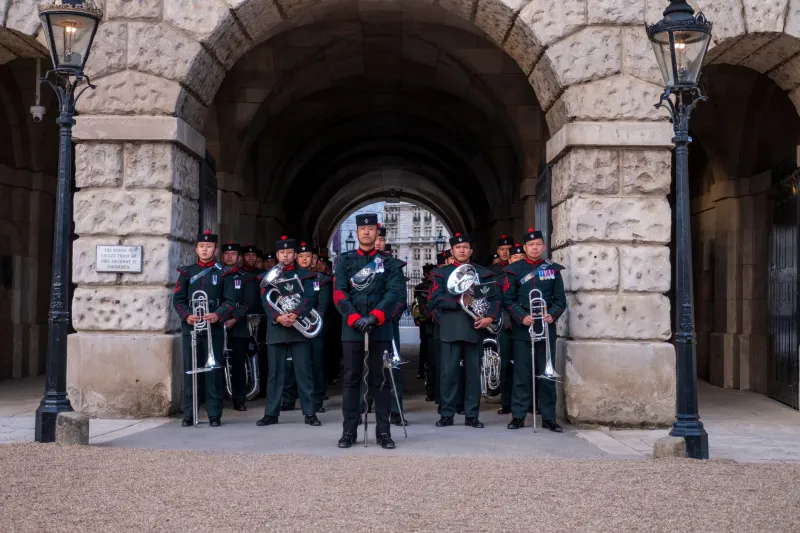
No institution better exemplifies the competitive musical spirit of Victorian Britain than the brass band contest, and no single event in that tradition surpasses the Belle Vue Championships in Manchester, inaugurated in 1853, and the National Brass Band Championships, which from 1900 onwards drew bands from across England to the Crystal Palace. These were occasions of extraordinary seriousness. Colliery bands, railway works bands, mill bands, and salvation corps rehearsed for months in preparation. The test pieces — often substantial arrangements of operatic overtures or specially commissioned original works — demanded technical accomplishment that would have impressed many a conservatoire-trained musician.
 Photo: Crystal Palace, via southlondonnews.co.uk
 Photo: Belle Vue Championships, via www.bellevue-speedway.com
What made these contests so culturally significant, however, was not merely the music but the social architecture surrounding it. A brass band was, in the most literal sense, a community enterprise. Instruments were expensive; coaching cost money; uniforms required communal fundraising. When the Besses o' th' Barn Band or the Black Dyke Mills Band took to the contest platform, they carried with them the accumulated investment — financial, emotional, and artistic — of an entire working community. Victory, when it came, was shared. Defeat was mourned collectively. The contest was, in this respect, a form of civic liturgy.
Wales and the Eisteddfod Tradition
If the brass band contest was England's characteristic contribution to competitive musical culture, Wales offered something older, stranger, and in certain respects more philosophically ambitious. The competitive eisteddfod, though rooted in medieval bardic tradition, underwent a dramatic transformation during the nineteenth century, emerging as a vehicle not merely for poetic and musical competition but for the articulation of Welsh national identity at a moment when that identity felt genuinely imperilled.
The National Eisteddfod, revived in its modern form at Llangollen in 1858, became an annual celebration of Welsh language, literature, and music that drew participants and spectators from across Wales and, increasingly, from Welsh diaspora communities in England and America. The competitive elements — the choral contests, the solo singing competitions, the bardic chair awarded for the finest poem in strict metre — were conducted with a solemnity that bordered on the sacred. To win the choral competition at the National Eisteddfod was, for a Welsh valley community, an achievement of the highest possible order.
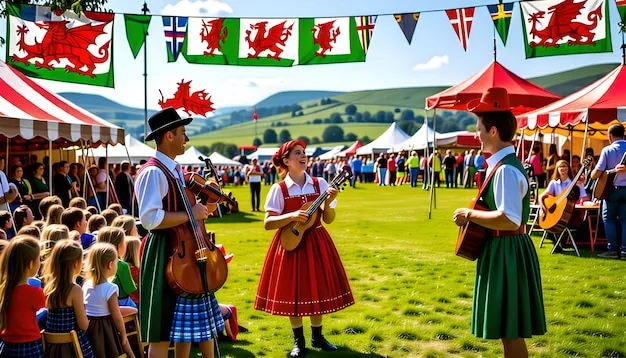 Photo: National Eisteddfod, via img.freepik.com
The eisteddfod tradition also demonstrated something that its English counterparts were slower to acknowledge: that competition, properly conducted, could be a form of mutual education. Adjudicators were expected not merely to rank competitors but to offer detailed, public commentary on each performance. Losing choirs frequently left the contest having learned more about their own capabilities than any number of private rehearsals could have taught them.
The Competitive Festival Movement in England
Beyond the brass band world, a parallel movement was taking shape in English towns and cities during the 1880s and 1890s. The competitive music festival — distinct from the older tradition of non-competitive choral festivals such as the Three Choirs — emerged as a vehicle for encouraging amateur performance across a broad social range. The movement is generally credited to John Spencer Curwen and Mary Wakefield, whose Westmorland Musical Competition Festival, established in 1885, provided a model that was swiftly imitated across the country.
By the Edwardian period, competitive music festivals were operating in hundreds of English towns. They encompassed solo singing, choral singing, instrumental performance, and eventually speech and drama. The competitive element was frequently controversial — distinguished musicians debated whether artistic endeavour should properly be subjected to the indignities of ranking and marking — but there was no denying the festivals' practical effect. They raised standards, created audiences, and offered performers from modest backgrounds a platform and a measure of public recognition that the established musical institutions would never have provided.
Careers Launched in Unlikely Arenas
The competitive festival circuit produced, over its long history, a remarkable number of musicians who subsequently achieved professional distinction. Kathleen Ferrier, born in Higher Walton, Lancashire, in 1912, first came to wider attention through her victories in the Carlisle and District Musical Festival during the 1930s, where her contralto voice earned the kind of adjudicators' praise that set careers in motion. Her trajectory from amateur festival competitor to one of the most celebrated singers of the twentieth century is the most luminous example of a pattern that repeated itself, in less spectacular form, many hundreds of times.
These were not, of course, straightforward meritocracies. Regional prejudice, social connections, and the particular tastes of individual adjudicators all played their parts. But the competitive festival circuit offered something genuinely unusual in the cultural life of Victorian and Edwardian Britain: a public arena in which talent, however obscure its origins, could assert itself and be acknowledged.
Has the Spirit Retreated or Merely Transformed?
The great age of the competitive music festival did not survive the twentieth century entirely intact. Two world wars, the transformation of working-class leisure, the rise of broadcast entertainment, and the gradual professionalisation of musical culture all took their toll. Many of the great brass band contests continued — Black Dyke Band and Grimethorpe Colliery Band retain their formidable reputations to this day — and the National Eisteddfod remains a fixture of Welsh cultural life. But the broader network of local and regional competitive festivals has contracted significantly, and with it something of the democratic musical energy that once animated British towns.
And yet it would be premature to declare that competitive spirit entirely extinct. The brass band world retains a vigour that frequently surprises those unfamiliar with it. The competitive festival circuit, administered today largely through bodies such as the British and International Federation of Festivals, continues to operate in dozens of towns. What has changed, perhaps, is not the existence of competition but its visibility — its capacity to command the public attention and the civic pride that once made a brass band victory in Manchester a matter of genuine communal consequence.
Britain's competitive musical heritage deserves to be remembered not as a curiosity of social history but as evidence of something deeply admirable: the conviction that artistic excellence is not the exclusive property of the formally trained, and that a community which competes together in the pursuit of beauty is, in some essential respect, a community that has understood what culture is for.