Symphony in Colour: British Artists Who Painted to the Rhythm of Classical Music
The Canvas as Concert Hall
In the quiet galleries of Britain's great museums, an extraordinary conversation unfolds between the arts—one that has shaped our cultural landscape for centuries yet remains largely unrecognised by the casual observer. Here hang paintings that were conceived not merely as visual experiences, but as direct responses to specific musical compositions, works where British artists attempted the seemingly impossible: to paint sound itself.
This tradition of musical painting represents one of the most sophisticated examples of artistic cross-pollination in British cultural history. From the Romantic movement through to the twentieth century, our finest painters have taken up brush and palette to engage in dialogue with symphonies, operas, and chamber works, creating visual interpretations that illuminate both arts in remarkable ways.
Turner's Symphonic Landscapes
J.M.W. Turner, that master of light and atmosphere, pioneered the British tradition of musical painting with works that responded directly to contemporary compositions. His 1844 masterpiece "Rain, Steam and Speed" was painted, according to contemporary accounts, whilst listening repeatedly to a specific movement from Beethoven's Pastoral Symphony, the artist seeking to capture in paint the same sense of natural forces in motion that the composer had achieved in sound.
 Photo: J.M.W. Turner, via cyberplan.it
More explicitly musical is Turner's lesser-known series of paintings inspired by Mozart's operas, particularly his visual interpretation of "The Magic Flute." These works, painted between 1845 and 1851, employ Turner's revolutionary technique to create visual equivalents for Mozart's musical architecture. The swirling, luminous forms that characterise these canvases mirror the opera's progression from darkness to light, whilst the artist's famous atmospheric effects seem to echo the work's supernatural elements.
Turner's approach was not mere illustration but genuine translation. He studied musical scores, attended performances, and worked to understand the structural principles underlying the compositions that inspired him. The result was a body of work that operated according to musical rather than purely visual logic, paintings that unfold in time like symphonies rather than revealing themselves in a single glance.
The Pre-Raphaelite Symphony
The Pre-Raphaelite Brotherhood, with their commitment to emotional intensity and symbolic meaning, proved natural inheritors of Turner's musical approach. Dante Gabriel Rossetti's series of paintings inspired by Wagner's "Ring Cycle" represents perhaps the most ambitious attempt by any British artist to create visual equivalents for musical drama.
Rossetti's "The Rhine Maidens" trilogy, painted between 1869 and 1871, translates Wagner's mythic narrative into visual form whilst capturing something more elusive: the emotional architecture of the music itself. The paintings' complex symbolism, rich colour harmonies, and intricate compositional relationships mirror the leitmotivic structure of Wagner's score, creating visual themes that develop and recombine throughout the series.
Edward Burne-Jones took this musical approach even further with his extraordinary series inspired by Bach's "Art of Fugue." Working with musician friends who would perform the compositions whilst he painted, Burne-Jones created abstract works decades before abstraction became fashionable, paintings where colour and form follow purely musical logic. These remarkable canvases, largely forgotten today, anticipate many of the developments that would later characterise twentieth-century art.
Whistler's Nocturnes: Music Made Visual
James McNeill Whistler, though American-born, created some of the most sophisticated musical paintings whilst working in London during the 1870s and 1880s. His famous "Nocturnes" series takes its title directly from Chopin's piano compositions, and Whistler's approach to paint mirrors the composer's approach to sound.
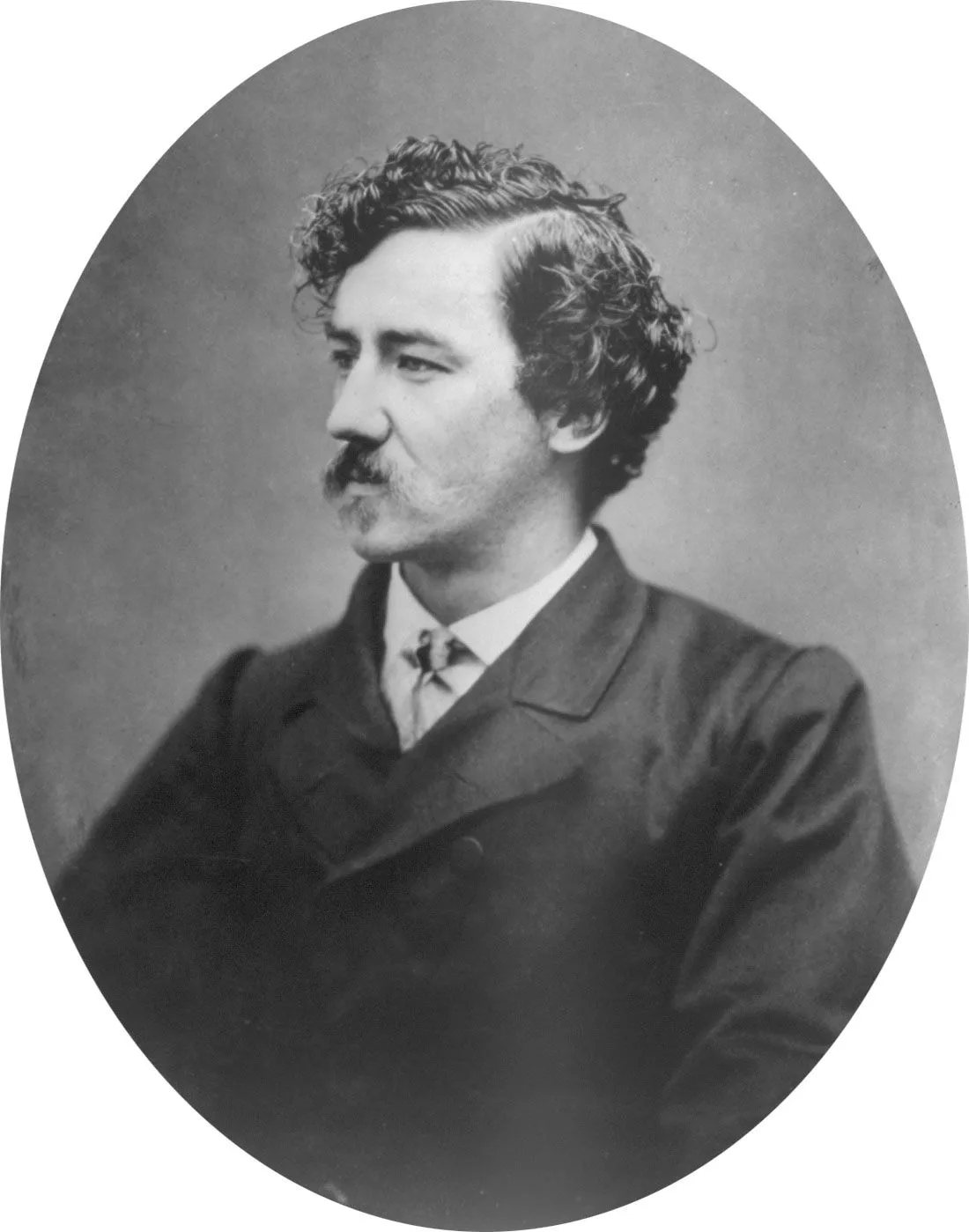 Photo: James McNeill Whistler, via cdn.britannica.com
Whistler's "Nocturne in Blue and Gold: Old Battersea Bridge" exemplifies this musical approach. The painting's tonal relationships, its careful balance of warm and cool colours, and its subtle gradations of light and shadow create visual equivalents for the harmonic progressions and melodic development found in Chopin's nocturnes. The work operates according to musical rather than representational logic, prioritising emotional effect over descriptive accuracy.
The artist's famous libel case against John Ruskin centred precisely on this musical approach to painting. When Ruskin accused Whistler of "flinging a pot of paint in the public's face," he was rejecting the very premise of musical painting—the idea that visual art could operate according to principles borrowed from music rather than traditional representational standards.
The Modernist Movement: Kandinsky's British Disciples
The early twentieth century saw British artists embrace even more radical approaches to musical painting, inspired partly by Wassily Kandinsky's theoretical writings on the relationship between colour and sound. David Bomberg's "In the Hold" series, created whilst listening to Stravinsky's "Rite of Spring," attempts to capture the revolutionary energy of the score through fragmented, angular forms that seem to pulse with rhythmic intensity.
Paul Nash, better known for his war paintings, created a remarkable series of works inspired by English madrigals and lute songs. These paintings, with their careful attention to linear development and harmonic colour relationships, translate the intricate polyphonic structures of Renaissance music into visual form. Nash's approach was deeply scholarly; he worked closely with early music specialists to understand the historical performance practices that would have shaped the original musical experience.
The Contemporary Legacy
This tradition of musical painting continues to influence British artists today. Bridget Riley's optical works, whilst not explicitly musical, employ principles of rhythm, repetition, and harmonic relationship that clearly derive from musical thinking. Her famous stripe paintings create visual experiences analogous to musical ones, engaging viewers in temporal experiences that unfold over time.
Peter Halley's recent series inspired by minimalist composers like Steve Reich represents perhaps the most sophisticated contemporary example of musical painting. Working with computer analysis of Reich's compositions, Halley creates paintings whose colour relationships and formal structures directly mirror the mathematical principles underlying the music.
The Deeper Conversation
What emerges from this survey is not merely a collection of curious artistic experiments, but evidence of a profound cultural conversation that has shaped British art for over two centuries. These musical paintings reveal how deeply interconnected our artistic traditions have always been, how painters and composers have engaged in ongoing dialogue that has enriched both arts.
Moreover, these works challenge conventional boundaries between the arts, suggesting that the most profound artistic experiences transcend the limitations of individual media. When Turner painted to Beethoven, when Rossetti visualised Wagner, when contemporary artists respond to minimalist compositions, they participate in a uniquely British tradition of artistic synthesis that continues to generate new possibilities for creative expression.
In our age of increasing specialisation, these musical paintings remind us that the greatest art has always emerged from the intersection of different creative traditions, from the willingness of artists to venture beyond the boundaries of their chosen medium in pursuit of more complete forms of expression.