The Unsung Architects
In the annals of British musical history, the spotlight typically falls upon celebrated composers and virtuoso performers. Yet behind every Elgar, every Vaughan Williams, and countless forgotten but accomplished musicians, stood figures whose contributions remain largely invisible: the music teachers who quietly revolutionised how an entire nation learned to listen, appreciate, and create.
From the Georgian era through the Victorian age, these pedagogical pioneers operated without institutional support or formal recognition. Working in parish schools, private drawing rooms, and makeshift village halls, they developed teaching methods that would fundamentally reshape British musical culture. Their legacy extends far beyond individual students – they created the very audience that would later sustain Britain's great musical institutions.
The Itinerant Masters
John Curwen stands as perhaps the most influential of these forgotten revolutionaries. A Congregationalist minister turned educator, Curwen recognised that traditional musical notation excluded vast swathes of the population from musical participation. His development of the Tonic Sol-fa system in the 1840s democratised musical literacy in ways that would have seemed impossible to earlier generations.
 Photo: John Curwen, via www.curwen.newham.sch.uk
Curwen's method replaced the intimidating complexity of staff notation with a simple system of syllables and hand signs. Within a generation, working-class choirs across Britain were tackling sophisticated repertoire that had previously been the preserve of cathedral schools and wealthy households. The system spread through Sunday schools, mechanics' institutes, and workers' clubs, creating a musical infrastructure that reached into every corner of British society.
Sarah Glover, working in Norwich decades before Curwen, had pioneered similar approaches. Her 'Norwich Sol-fa' system influenced not only Curwen but also sparked a broader movement towards accessible musical education. Glover understood that musical literacy was not merely about reading notes – it was about developing the ear, the voice, and the musical imagination simultaneously.
 Photo: Sarah Glover, via images.squarespace-cdn.com
The Drawing Room Academies
In more affluent circles, a different revolution was unfolding. Private music teachers, particularly women who found in musical instruction one of the few respectable forms of independent income, were transforming domestic musical culture. These teachers, working in drawing rooms across Georgian and Victorian Britain, developed pedagogical approaches that balanced technical excellence with musical understanding.
Figures like Muzio Clementi, though Italian-born, exemplified this tradition. His teaching methods, combining rigorous technique with musical sensitivity, influenced generations of British pianists. More importantly, his approach to musical education emphasised the development of taste and judgement alongside technical facility – creating musicians who could think as well as perform.
The impact extended beyond individual households. These teachers created networks of musical families, with knowledge and appreciation passing from generation to generation. They understood that musical education was not merely about creating performers but about cultivating audiences capable of sophisticated musical engagement.
The Community Builders
Perhaps most remarkably, these educators understood music's power to build community. In an era before mass media, musical education served crucial social functions. Village teachers who organised singing classes created spaces for collective expression and shared cultural experience. Their methods recognised that musical learning was inherently social – that voices learned best in harmony with others.
This philosophy produced results that seem almost miraculous by contemporary standards. By the 1870s, working-class choirs were performing Bach cantatas and Handel oratorios with remarkable sophistication. The Three Choirs Festival, originally an elite gathering, found itself influenced by musical standards that had percolated upward from community-based musical education.
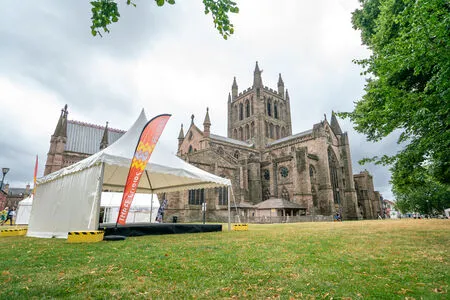 Photo: Three Choirs Festival, via www.festivalfinder.eu
The teachers achieved this not through dumbing down musical content but by making sophisticated musical thinking accessible. They understood that musical appreciation could not be separated from musical practice – that the deepest understanding came through active engagement rather than passive consumption.
Revolutionary Methods
What made these educators truly revolutionary was their rejection of purely technical approaches to musical training. Instead of focusing solely on mechanical skill development, they emphasised musical understanding, creative expression, and community participation. Their methods recognised that musical education should develop the whole person, not merely technical proficiency.
This holistic approach produced musicians who could adapt, improvise, and think musically rather than merely execute predetermined patterns. The flexibility and musical intelligence fostered by these methods created a generation capable of embracing new musical developments whilst maintaining connection to established traditions.
The Enduring Legacy
The influence of these forgotten pioneers extends far beyond their immediate historical moment. The community-based approach to musical education they championed created the cultural foundation that would later support Britain's great musical institutions. The audiences who filled the Queen's Hall for Henry Wood's Promenade Concerts had been prepared by generations of teachers who understood that musical appreciation required active cultivation.
Today, as music education faces unprecedented challenges, the example of these early pioneers offers compelling insights. Their success stemmed not from institutional resources or formal qualifications but from deep understanding of music's social and cultural functions. They recognised that musical education was ultimately about creating communities of shared cultural experience.
Lessons for Today
Perhaps most urgently, these forgotten educators remind us that excellent musical education need not depend upon expensive institutions or elite training. Their methods, rooted in accessibility and community engagement, achieved remarkable results through dedication, innovation, and deep musical understanding.
As contemporary music education struggles with funding cuts and institutional pressures, the example of Britain's musical education pioneers suggests that the most profound musical learning often happens in the most humble circumstances – guided by teachers who understand that music's greatest power lies not in technical perfection but in its capacity to transform individuals and communities alike.