Literary Pilgrimages: Where England's Greatest Stories Were Born
Across England's green and pleasant land lie scattered the wellsprings of our greatest literary treasures—landscapes so integral to their creators' vision that they became characters in their own right. These are not merely pretty places that happened to house famous writers, but the very soil from which immortal stories grew, their seasonal rhythms and ancient contours shaping the imagination of generations.
The Lake District: Wordsworth's Sacred Ground
No literary landscape holds greater significance in English poetry than the Lake District, where William Wordsworth discovered that nature itself could be both teacher and muse. Dove Cottage in Grasmere, where Wordsworth penned some of his finest verses, remains a shrine to the Romantic movement. The surrounding fells and tarns, immortalised in "I Wandered Lonely as a Cloud," continue to bloom with daffodils each spring, their golden hosts dancing in the same breezes that stirred the poet's imagination.
Visitors can trace Wordsworth's daily walks along the shores of Rydal Water, where he composed aloud whilst pacing the gravel paths he wore smooth with his restless creativity. The view from Helm Crag, which he dubbed "the Lion and the Lamb" for its distinctive rock formations, offers the same sublime prospect that convinced Wordsworth of nature's profound spiritual significance.
Coleridge, too, found inspiration in these hills, his residence at Greta Hall in Keswick providing the setting for some of English literature's most mysterious and haunting verses. The relationship between landscape and literature here runs so deep that the very stones seem to whisper fragments of "Kubla Khan" and "The Rime of the Ancient Mariner."
Hardy's Wessex: Dorset's Timeless Drama
Thomas Hardy's fictional Wessex, centred on his beloved Dorset, represents perhaps literature's most completely realised landscape. Here, ancient trackways and stone circles provide the backdrop for tales of passion, tragedy, and rural transformation. Hardy's birthplace at Higher Bockhampton, a cob-and-thatch cottage hidden amongst heathland, remains virtually unchanged since the novelist's childhood.
Egdon Heath, the brooding protagonist of "The Return of the Native," stretches across the Dorset downs with the same wild melancholy that Hardy captured in prose. The heath's gorse-covered expanses and hidden valleys embody the eternal struggle between human ambition and natural forces that runs through all Hardy's work.
Casterbridge—Hardy's fictional name for Dorchester—retains much of its market-town character, its ancient amphitheatre and medieval streets providing tangible links to "The Mayor of Casterbridge." The surrounding countryside, with its chalk downs and hidden combes, offers countless walks through scenes that inspired "Far from the Madding Crowd" and "Tess of the d'Urbervilles."
Brontë Country: Yorkshire's Passionate Heights
The Yorkshire moors surrounding Haworth Parsonage shaped the Brontë sisters' dark romanticism like no other landscape could. These windswept heights, where heather blooms purple each autumn and curlews cry their haunting songs, provided the perfect setting for the tempestuous passions of "Wuthering Heights" and "Jane Eyre."
Top Withens, the ruined farmhouse that inspired Wuthering Heights itself, stands exposed to every weather on the high moor, its stone walls blackened by Yorkshire's fierce winds. The walk from Haworth across these moors follows paths the sisters knew intimately, their daily constitutionals providing both physical exercise and creative inspiration.
The Parsonage Museum preserves the intimate domestic world where three of literature's greatest novels were written, often by candlelight around the dining room table. Charlotte's tiny books, written in microscopic hand, and Emily's sparse personal effects speak of lives lived intensely within narrow bounds, their imaginations soaring far beyond the confines of their isolated home.
Austen's Hampshire: Elegance in the English Countryside
Jane Austen's Hampshire, centred on the village of Chawton, embodies the refined domesticity of Regency England. The cottage where Austen revised "Pride and Prejudice" and wrote "Emma" sits on the Winchester road, its modest rooms belying the revolutionary social observation that emerged from within its walls.
The surrounding countryside, with its gentle hills and ancient churches, provides the perfect setting for Austen's comedy of manners. Box Hill in Surrey, scene of Emma Woodhouse's social catastrophe, offers views across the Weald that encompass the entire world of Austen's imagination—a landscape of country estates, market towns, and social hierarchies that she dissected with surgical precision.
Winchester Cathedral, where Austen lies buried, honours the novelist with a simple grave that belies her enormous influence on English literature. The cathedral's soaring Gothic arches provide a fitting monument to a writer whose wit and wisdom continue to illuminate the human condition.
Shakespeare's Warwickshire: The Heart of England
Stratford-upon-Avon, Shakespeare's birthplace, sits at the heart of England both geographically and culturally. The market town on the River Avon, with its Tudor buildings and ancient churches, provided the young playwright with his first glimpse of human nature in all its variety. The nearby Forest of Arden, though much diminished since Shakespeare's time, still echoes with scenes from "As You Like It."
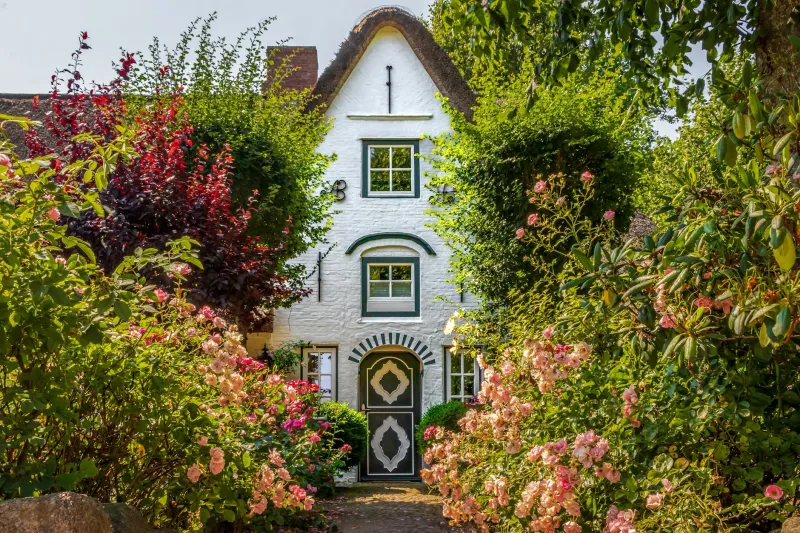
Anne Hathaway's Cottage in Shottery, with its thatched roof and traditional English garden, represents the domestic world that anchored Shakespeare even as his imagination ranged across continents and centuries. The cottage's herb garden and orchard bloom with the same flowers that perfume the comedies, their seasonal cycles reflecting the natural rhythms that underpin even Shakespeare's most fantastic plots.
Dickens's Kent: Childhood and Memory
Charles Dickens's childhood in Kent left indelible marks on his imagination, the county's marshes and ancient towns providing settings for some of his greatest works. Gad's Hill, the house Dickens admired as a child and later purchased as a successful author, overlooks the Medway estuary where "Great Expectations" unfolds its tale of ambition and disillusion.
Rochester, with its Norman castle and cathedral, appears throughout Dickens's novels as a symbol of England's layered history. The city's narrow streets and ancient buildings, little changed since Dickens's time, offer visitors the chance to walk through scenes from "The Pickwick Papers" and "Edwin Drood."
A Living Heritage
These literary landscapes remain vital parts of England's cultural ecosystem, their beauty and significance drawing visitors from across the world. They remind us that great literature emerges not from abstract imagination alone, but from deep engagement with particular places and their unique character.
Each season brings fresh revelations to these hallowed grounds—spring bluebells in Hardy's woods, summer roses in Austen's gardens, autumn mists on the Brontë moors, winter frost on Wordsworth's fells. The literature they inspired continues to illuminate these landscapes, whilst the landscapes themselves deepen our understanding of the works they nurtured.
For those who seek to understand England's literary heritage, these pilgrimages offer something no library or lecture hall can provide—the chance to experience the very sources of inspiration that created our greatest stories. In walking these paths and breathing this air, we join an unbroken chain of readers and writers who have found in England's landscape not merely scenery, but the very stuff of dreams.