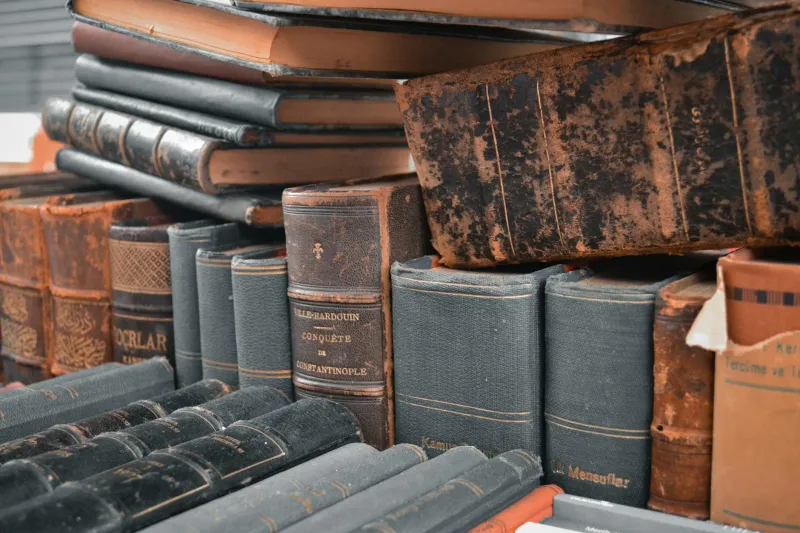
The Alchemy of Leather and Gold
In the hushed reading rooms of Britain's great libraries, a careful observer might glimpse them still: books so exquisitely bound that they seem to glow with their own inner light. Tooled in gold, bound in morocco leather, and decorated with intricate patterns that speak of countless hours of patient craftsmanship, these volumes represent one of Britain's most overlooked artistic traditions.
Long before the Industrial Revolution reduced bookbinding to a mechanical process, this ancient craft occupied a position of extraordinary prestige within British cultural life. Master bookbinders were artists in the truest sense, transforming functional objects into works of decorative magnificence that could hold their own beside the finest silverware or furniture of their age.
Guild Traditions and Royal Patronage
The story begins in Tudor England, where the Stationers' Company held dominion over London's book trade. Within their ranks, the most skilled craftsmen commanded respect that extended far beyond their workshops. These were not mere tradesmen but artists whose work graced the libraries of monarchs and nobles.
Henry VIII's personal library contained volumes bound with such splendour that contemporary accounts describe them as 'more precious than jewels.' The king's bindery, housed within Westminster Palace, employed craftsmen who had trained in the workshops of Paris and Venice, bringing Continental techniques to English shores whilst developing distinctly British approaches to decoration.
 Photo: Westminster Palace, via c8.alamy.com
The Elizabethan era witnessed an explosion of creative ambition. Bookbinders began incorporating heraldic devices, personal emblems, and elaborate border designs that transformed each volume into a unique work of art. Christopher Plantin's workshop in Antwerp influenced a generation of English craftsmen, yet British binders developed their own aesthetic language—one characterised by restrained elegance rather than Continental flamboyance.
The Golden Age of Decoration
By the seventeenth century, British bookbinding had achieved a sophistication that impressed even Continental observers. The workshop of Samuel Mearne, bookbinder to Charles II, produced volumes of such extraordinary beauty that examples now command astronomical prices at auction.
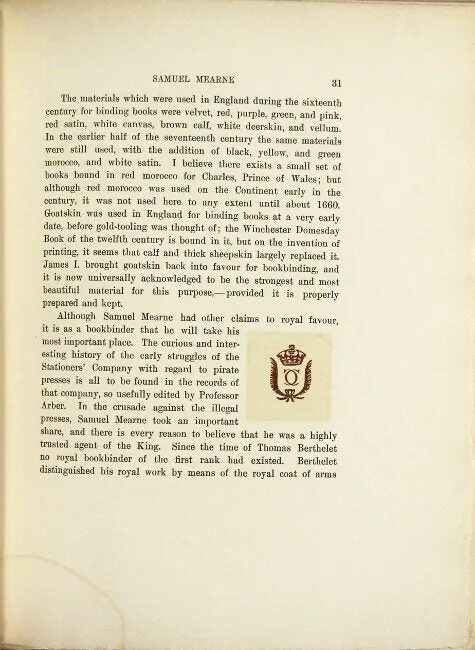 Photo: Samuel Mearne, via pictures.abebooks.com
Mearne's innovations included the development of 'cottage' bindings—so called for their distinctive roof-like patterns—and the perfection of techniques for applying gold leaf with unprecedented precision. His workshop trained a generation of craftsmen who would carry these skills throughout Britain's expanding empire.
The eighteenth century brought new levels of refinement. Workshops in Edinburgh, Dublin, and provincial centres began challenging London's supremacy, each developing regional characteristics that reflected local tastes and traditions. Scottish binders, influenced by Continental Protestant traditions, favoured geometric patterns of austere beauty. Irish craftsmen incorporated Celtic motifs that had survived centuries of cultural upheaval.
Victorian Splendour and Industrial Challenge
The Victorian era represented both the pinnacle and the beginning of the end for traditional bookbinding. Wealthy industrialists commissioned bindings of unprecedented elaboration, often incorporating precious stones, ivory panels, and silver clasps that transformed books into objects of pure luxury.
Firms like Riviere & Son and Sangorski & Sutcliffe created bindings that took months to complete, employing dozens of craftsmen in workshops that resembled medieval guilds. Their masterpieces—including jewelled bindings of Omar Khayyam and illuminated prayer books for royal weddings—represented the absolute summit of the binder's art.
Yet even as these workshops reached new heights of technical achievement, industrial machinery was beginning to transform the trade. Steam-powered presses and mechanical folding equipment reduced binding costs dramatically, making elaborately decorated volumes seem increasingly anachronistic.
Techniques Lost and Found
The traditional bookbinder's workshop was a place of extraordinary complexity. Master craftsmen required years to perfect techniques for preparing leather, mixing gold leaf adhesives, and cutting the intricate brass tools used for decoration. Apprentices spent decades learning to judge the exact pressure required for different leathers, the precise temperature for applying gold, and the subtle variations in technique required for different styles of decoration.
Many of these skills died with their practitioners. The secret of certain leather preparations, the formulae for particular adhesives, and the methods for creating specific decorative effects vanished as workshops closed and masters retired without passing on their knowledge.
Contemporary Guardians
Yet the tradition has not entirely disappeared. In workshops scattered across Britain, a small but passionate community of craftsmen maintains the ancient skills. The Designer Bookbinders society, founded in 1951, has worked tirelessly to preserve traditional techniques whilst encouraging contemporary innovation.
Figures like Ivor Robinson and Philip Smith have demonstrated that traditional bookbinding can evolve without losing its essential character. Their work, displayed in galleries rather than libraries, has helped establish bookbinding as a legitimate contemporary art form.
Institutional Treasures
Britain's great libraries and museums house extraordinary collections of historic bindings, though many remain hidden from public view. The British Library's collection includes examples from every period of British binding history, whilst the Bodleian Library at Oxford possesses bindings that date back to the medieval period.
 Photo: British Library, via www.e-architect.com
Private collectors continue to seek out historic examples, driving prices to levels that reflect growing recognition of bookbinding as a legitimate art form. Recent auction results suggest that the finest examples now command prices comparable to important paintings or sculptures.
The Future of an Ancient Craft
As digital technology transforms our relationship with books, traditional bookbinding faces an uncertain future. Yet perhaps this very uncertainty has created new opportunities. Contemporary artists are discovering that hand-bound books possess qualities—tactile richness, visual complexity, and physical presence—that no digital medium can replicate.
The survival of Britain's bookbinding tradition depends upon more than nostalgia. It requires recognition that these craftsmen were not merely decorating functional objects but creating works of art that embodied the highest aspirations of their age. In their patient labour, we glimpse something essential about British cultural character: the belief that beauty and utility need not be enemies, and that even the most humble objects deserve our finest efforts.